Author: Pete Whelan
Journalist, Melbourne.
Melbourne Music Community Rages as Tote Owners Double Down (Audio/Article)
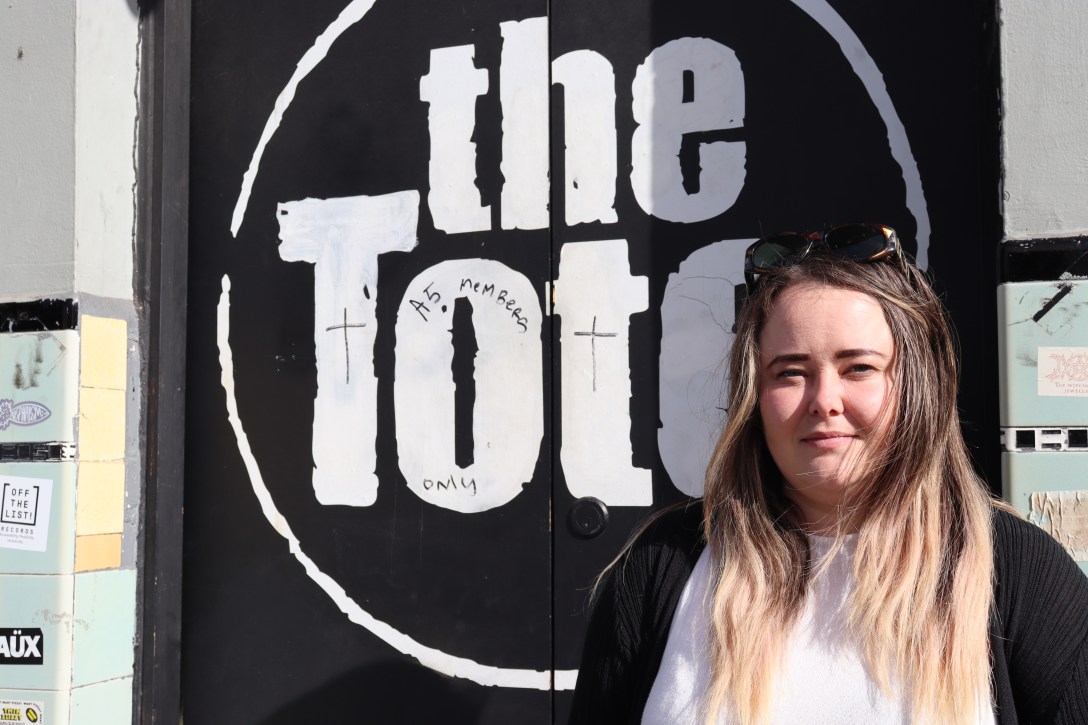
Peter Whelan
April 25, 2023
The notoriously sticky carpets of the Tote have played host to generations of Melbourne’s music fans over the decades, as well as plethora of Australian rock royalty from local legends like Paul Kelly, You Am I, and the Hoodoo Gurus to international stars including the White Stripes and Mudhoney.
The venue was recently listed for sale , now finding itself in the midst of escalating controversy following an unexpected change in sale conditions after a successful crowdfunding campaign that sought to secure its future as a live music venue.
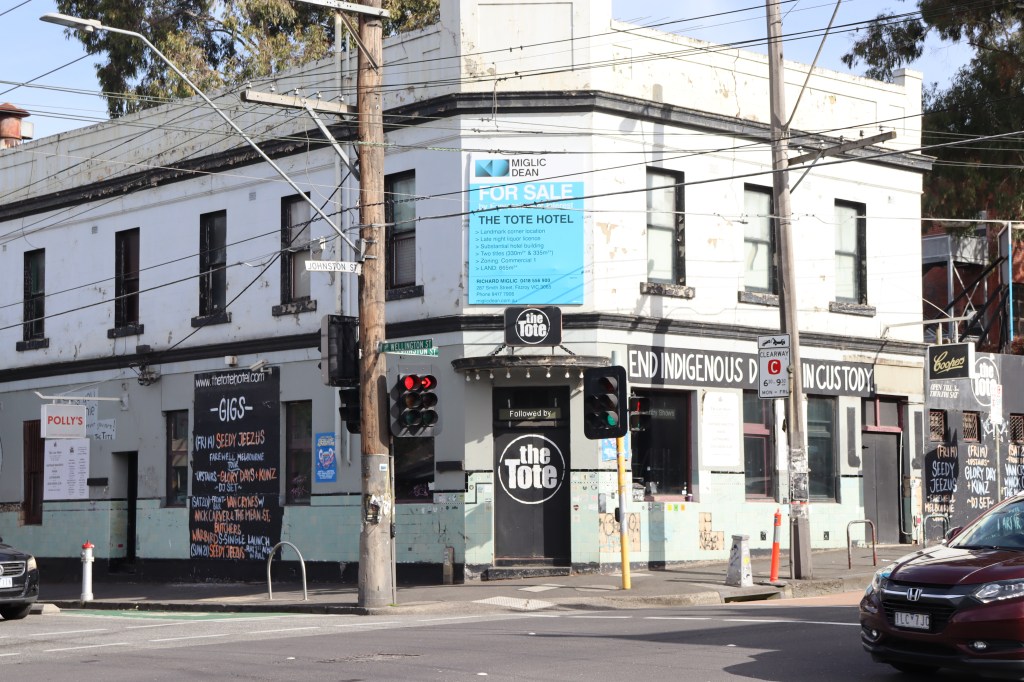
Eager to prevent the sale of the venue to property developers, Last Chance Rock & Roll Bar owners Shane Hilton and Leanne Chance had launched a crowdfunding campaign with the goal of buying the Tote and placing it in a public trust in order to give it “to the bands of Melbourne forever.”
Hilton and Chance pledged $3 million of their own money and sought to raise an additional $3 million from the public campaign on crowdfunding platform Pozible.
“Let’s not beat around the bush…”, the campaign description began,
“THE TOTE IS GOING TO BE TURNED INTO APARTMENTS (or worse one of those fucking awful redeveloped tissue box pubs ran to make as much money as possible with no dirty rock & roll in sight…”
“In other words, the Tote is dead and some asshole developer is going to get it,” it continues.
“We’ve managed to hustle and can (with going into a shit load of debt to banks, family and using our own meagre [sic] savings) manage to put up half of that money.
“What we need to do is raise the other half.”
As part of the campaign, Hilton vowed to tattoo the names of all contributors on his body and the Last Chance hosted all-night live streams featuring performances from local artists as the live music community rallied to save the venue.
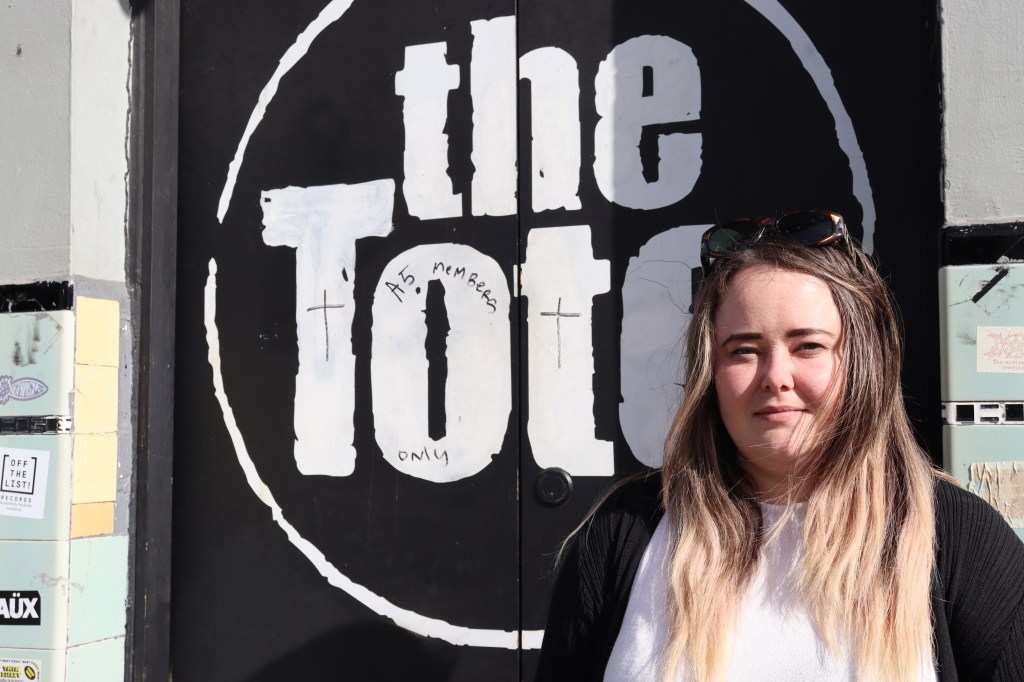
Among those who contributed to the crowdfunding campaign was Asia Taylor, part owner and band booker of Abbotsford live music venue Lulie Tavern, band photographer and co-host of music podcast the L Files.
I asked Asia what motivated her to contribute to the Save the Tote campaign.
“I wanted to support Shane and Leanne,” she said.
“It got to a couple $100,000 pretty quickly, and when it hit a million, I realised that it could be possible and it could be saved. I thought, ‘I need to be a part of this.’ There’s some amazing memories there, and if I had the money, I’d save it as well.”
On March 6, the Save the Tote campaign reached its three million dollar goal, a record amount for the Pozible platform.
However, a matter of hours later, a post appeared on the Tote’s Instagram account from Tote owners Sam Crupi and Jon Perring.
“The Tote would like to thank everyone that pledged to the Last Chance Pozible campaign to try and buy the Tote. It’s a stunning result for the community to reach the $3m target,” the post began, before shifting in tone.
“The current asking price is $6.65m and is based on the land value,” the post began, explaining that the owners had arrived at the figure with help from a “respected and qualified valuer” to allow for “the mortgage, all liabilities and the current owners to be paid out fairly.”
“The price is possibly even conservative by some measures,” Perring and Crupi wrote, suggesting that “governments and private philanthropy would need to come on board” to address the “shortfall between community pledges.”
Commenters were swift to express their disdain in the comments section.

That night at the Tote, punk band Uncle Geezer left the stage after playing only one song in protest over Crupi and Perring’s decision.
“If you don’t know what’s going on, look at the Tote page,” said a band member. “Fuck this place, it deserves to get sold to Hillsong. You guys want the whole set? Come to Last Chance tomorrow. Enjoy the rest of the set, that will be six hundred thousand dollars.”
Uncle Geezer invited the audience to their free Last Chance Rock & Roll bar show the next day, where every ticket had been paid for by an unnamed ‘prominent member of Melbourne’s music industry.’
Negotiations between the Last Chance owners and the Tote owners are ongoing, but Hilton remains optimistic.
“The journey is still continuing,” he told Broadsheet .
“The campaign ending didn’t mean it would automatically sell, but we are confident we’ll get the purchase.”
Appraising the Intangible: Victoria’s Cultural Heritage Problem (Feature Article)
Deep into the heart of Melbourne’s CBD, I roamed. I had been led on a fool’s errand, and now found myself blindly fumbling through peak-hour foot traffic, searching for a non-existent parcel collection point. I heard a familiar voice call out to me. Looking around, I couldn’t find its source among the blank, vaguely discontent faces of the rat race. “Pete!” the voice cried again. That’s when I realised it was coming from inside the construction site. I poked my face through a gap in the fence and found myself face-to-face with an old friend: Ian Ostericher.
I first met Ian on his wedding night. After tying the knot, he and his new bride Bianca had decided on a whim to visit Lulie Tavern, the dive-bar in Abbotsford where I work. After I insisted on toasting their new union with the Tavern’s finest tequila – Clase Azul Reposado – the three of us became fast friends.
Ian is an archaeologist. For many, the mention of archaeology conjures images of exotic adventure in Greece or Egypt, but this site was a salvage excavation of Aboriginal artefacts, Ian said, explaining that Melbourne’s CBD stands on land rich with Indigenous history, the archaeological extent of which is unknown.
My curiosity piqued, I lured Ian to the Tavern to tell me more that evening with the promise of one of my famous margaritas and hurried home to do some research before my shift. Before I knew it, we’d set up an interview to be conducted over still more margaritas.
After some research, I discovered the junction of three remarkably different realms: commerce, science and spirituality: the world of Cultural Heritage Management. This is legislation created by the Aboriginal Heritage Act in 2006 that established corporations composed of traditional land owners called Registered Aboriginal Parties (RAPs). Their primary role, as laid out by the Act, is to function as the “primary guardians, keepers and knowledge holders of Aboriginal cultural heritage” of the land they represent.
When a development is proposed within a RAP’s boundaries, the developers must first consult with the Elders of the RAP to determine if the land is an area of cultural sensitivity. If so, that developer must hire an archaeologist certified in heritage management, in this case Ian, to create a Cultural Heritage Management Plan assessing the extent of Aboriginal heritage in an area, as well as plans for its preservation and maintenance should the development proceed.
After being appointed Cultural Heritage Manager for a site, Ian first conducts a ‘desktop assessment’ to gather the stories, history, and background data of the area through his own research and consultation with the RAP.
“What does that involve?” I asked Ian as a Tommy’s margarita was set down before him.
“I’ll ask if there are any stories about this part of the world that have any bearing on what we might find, or on how we should be dealing with it, sensitivity-wise,” he replied.
Do we know if there was women’s business, or men’s business or sorry business here? An example would be, now we actually know that this is an area that has a lot of women’s business, then we only have women run the project. So men don’t touch any of the data, men don’t touch anything, and then reports are redacted according to who can view it. You’re saying like, hey, look, we are on your side. We really care,” Ian said
Next, his team conduct standard and complex assessments of the land itself under the supervision of the RAP. The first is a survey, looking for unburied artefacts and surface damage which could affect the potential archaeology below. The second is a subsurface excavation of test squares to determine the concentration of artefacts on the site. In the event of high artefact concentration, a salvage excavation is carried out to unearth and preserve the objects.
“It’s important to remember that these places aren’t just archaeological sites. The information that they contain is, in a lot of ways, sacred to Aboriginal people,” Ian explains. “It’s the interaction between the land and the object. When we do repatriations and reburials, we do a smoking ceremony and then rebury the objects on the same type of landform they were excavated from in a bottomless box, so it’s still in contact with the earth. We also bury it with the ontological report. Almost like a little time capsule. So you’re paying homage to both lineages of knowledge.”
Every link in the chain of Cultural Heritage Management ascribes value differently. For the Aboriginal people, it is a spiritual connection to Country. For the archaeologist, it is discovery and science. For the developer, it is business – the completion of a project to their client on time and on budget. Ian’s job, translating between these different spheres, seemed like alchemy to me.
“On any particular job, I have three clients,” Ian said. “As a business, I’ve got a financial obligation to the developer. Then there’s the ethical client – the science of collaborative practice. Making sure the claims that we’re making about the past are as evidenced as well we possibly can make them where we don’t over-interpret or under-interpret evidence. And then, third, there’s the moral client in the traditional owners of the land. My work is sometimes at odds with the idea of self determination and the control of their own land. It’s difficult. ”
To get a better idea of the different forces at work in this challenging exercise, I spoke to another of my regulars at Lulie Tavern. Tom Muratore has an extensive background in commercial and multi-residential property development in Melbourne. I’d noticed that the flow of money during the heritage management process came exclusively through the developer, who pays the archaeologists, the supervising members of the Registered Aboriginal Party, and consultation fees for every meeting with the party Elders. The Heritage Act seemed to me to support privatisation and a resulting lack of transparency that I hoped Tom could explain to me.
I met with him in his company’s showroom to discuss the Cultural Heritage Management process from his point of view. Warm and obliging, Tom put a pot of filter coffee on for us while fielding endless phone calls from Chinese supply companies and obscenely wealthy clients who wanted their antique chair legs dipped in brass.
“I want to make one thing clear,” Tom cut in curtly as I waxed lyrical to him about my impressions. “It’s got nothing to do with the developer. Everyone now just anticipates [Cultural Heritage Management] happening and adds a fee on to it. And as it gets worse, the prices have been escalating. The price of real estate in Australia is caused by this kind of bureaucracy. Our building cost in Victoria is higher than anywhere else in Australia.”
“I just think we’re just generating work. How does money solve a heritage problem? Where does that money go? Is that money going directly to Aboriginal communities? Or is it going into another bureaucracy?”
It’s clear that Tom comes from a very different place to Ian. His concerns are based on the completion of the job he has been contracted to do. His frustration with the bureaucratic process is also echoed by other developers in Victoria.
In submissions to the Victorian Government’s Inquiry into Establishment and Effectiveness of Registered Aboriginal Parties, Westwind Energy wrote that over $750,000 was “required to be spent without any certainty that a project would be approved on cultural heritage grounds, let alone other planning grounds,” while VicRoads wrote that many RAPs “are now charging rates substantially higher than those recommended in the Guidelines in what has become a highly inflationary unregulated charging environment.”
There were also several submissions to the Inquiry, many heavily redacted, from traditional land owners. Many had seen their application for RAP status denied or ignored by the Victorian Aboriginal Heritage Council, resulting in loss of income and community credibility. When a traditional land owner is excluded from RAP status, they cannot hold events that generate money for their communities, like traditional smoking ceremonies and speeches of welcome.
In his statement to the Inquiry, Neil Clark of the heritage advisory firm Clarkeology said the process of RAP appointment “is a competitive application process whereby two groups come in and they are both really being asked to say, ‘My claim for historical connection is stronger than your claim for historical connection’. Usually there is only one group selected, so there are winners and losers. It just seems to me that is an inherently unfair process. I do not dispute that the groups who have got RAP status deserve RAP status, but what about everybody else?”
To better understand the spiritual connection between Aboriginal people and Country, I reached out to Emily Poelina-Hunter, whose status as Reconciliation Lead for the City of Melbourne, lecturer of Aboriginal Studies at La Trobe University, doctor of archaeology and Aboriginal woman put her in a position to provide unique insight. I wanted to know if it was possible for a Cultural Heritage Management Report to sufficiently communicate the importance of Country in Aboriginal culture.
“I definitely think there is a way that the spiritual importance of Country can be written about in English for CHMPs,” Emily said, “but I think it would be best done by an Indigenous writer who is comfortable with academic scientific English – because this is a bit different to conversational everyday English. Translating anything from an Aboriginal language into English is hard enough to find equivalent words with similar meaning. And then anthropologists and archaeologists use their own academic terminology and categorise things in ways that kind of don’t always capture the essence of Aboriginal words.
“And when it comes to something seemingly intangible – like spiritual connection to Country – it is super hard to put something that complex into words.
“I’ve been watching Selling Houses Australia on Foxtel, and the respect for 1920s art deco bathrooms, or a 100 year old house built during the gold rush in Bendigo blows my mind. Or people having to sell a house that has been in their family for 80 years is really sad. Give me a break! If they get that, why can’t they just times it by 500 and grasp 1000s of generations of families being connected to and caring for Country?”
Emily’s comparison to Selling Houses Australia was apt. Ascribing value to Aboriginal connection to Country seemed like an exercise in metaphysics, particularly through the bureaucratic maze of the Heritage Act. But what’s the alternative, and should we be appraising the intangible at all?
Pete Whelan
Implantable Technology on the Rise (TV Package)
Implantable technology is gaining popularity, seeing people insert microchips under their skin to unlock doors, tap on on public transport and to make contactless payment in shops.
Most chips weigh less than a gram and are about the size of a grain of rice. These tiny biopolymer enclosures contain a chip and an antenna that uses is near-field communication or NFC, similar to the contactless payment technology in a smart-phone.
Part of a movement known as biohacking, implantable technology shows no signs of slowing down as the relationship between humans and technology grows closer.
How Australia’s Relationship with Alcohol is Changing (Data Story)
The Game of Love, and How COVID Changed the Rules (Colour Story)
COVID has changed dating forever. Happenstance flings in clubs and romantic nights out on the town have been rendered ancient history as the compounding loneliness of endless lockdowns has largely moved romance into the realm of online dating.
A daunting proposition to begin with, the pitfalls of the online dating scene have only been magnified by social-distancing, curfews, the vaccination status of potential partners, and of course, the risk of catching a life-threatening virus.
Many of Melbourne’s brave singles have nevertheless risen to the challenge of trying to negotiate love in this brave new world, their journeys leading them from popular dating apps like Hinge and Tinder to walking trails and parks within their government-sanctioned travel radiuses.
These experiences have led many to re-evaluate the role of dating in their lives, the changing nature of the “getting-to-know-you” process and the difference that natural lighting makes in the time-honoured dance of courtship.
“I’m the kind of person who meets people randomly at pubs or at festivals and that’s how relationships start for me,” says Nkechi, 31, who had sworn off dating apps before the pandemic.
After holding out for the first year of Melbourne’s lockdown she reluctantly joined the online dating community despite some initial scepticism.
“In the first year of lockdown, I was like ‘what’s the point?’” she said.
“All you could really do was walk around the park wearing a mask, which left me feeling pretty disheartened,
“This year, though, I was a bit sick of talking to the same people all the time and really wanted to meet somebody new, so I started back on the apps.”
For Nkechi, though, the vetting process of online dating lacks the sense of spontaneous connection that she’s looking for.
“Having to think about it a lot really changes things,” she said.
“Not to say that I’m completely reckless, but before COVID I was totally happy to go out for the night just drinking, and to hook up with somebody.
“It wasn’t about ‘do I want to be in a long-term relationship’ with this person.”
“Socialising felt quite new” after being locked down for a while, Nkechi said, and the art of small talk has suffered as a consequence.
“You quickly realise that you and the person you’re on a date with are both slightly traumatised by the COVID scenario,” she said.
“You’re trying to get to know somebody at a distance and you’re trying to have conversations to explain who you are, but for the last two years you’ve been doing what everyone else has been doing – nothing!
“All I could think about was ‘could I stand being confined in a small space with this person for a long period of time?’
“Someone asked me, ‘how are you going?’ I’m like, ‘probably the same as you, dude. I’ve just been doing fuck all. Like, I don’t know what to tell you.’
Tony, 33, is a musician and chef who has had a markedly different set of dating experiences over the pandemic. Much more comfortable with the online environment and largely unable to work in hospitality, his love life “blossomed”.
“It actually flourished for me because I’m usually working a lot, especially at night-time,” he said.
“I live solo, so you could have a bubble – I’d meet up in a park for a wine and if things went well, we’d rendezvous at one of our places.”
When meeting people online, Tony noticed that a lot of Tinder users had recently included their vaccination status in their bios as “a sort of pickup line”.
“A lot of people put it in their Tinder bios, ‘full-vaxxed’ and the like – I’ve seen a couple of anti-vaxxers on there too, he said.
“It’s definitely a divided thing.”
Despite this, however, Tony found the venues of his dates, public parks filled with families, to be “quite a strange setting” for romance.
“I’d bring a bottle of wine and some cheese usually,” he said.
“Although I did feel quite self-conscious at times because of all the families and stuff in the park.
“It shone a light on social protocols that happen in the dating world that I wasn’t necessarily even aware of.”
IATSE Deal on Working Conditions ‘Not Enough’, Union Members Say (Hard News Story)
Members of the International Alliance of Theatrical Stage Employees have expressed dissatisfaction with a last-minute deal struck yesterday with major Hollywood studios to prevent an industry-wide strike over pay and working conditions.
The deal, yet to be ratified by union members, addressed long-held concerns in the industry over dangerously long working hours and guaranteed a 10-hour rest period between daily shoots, as well as 3% annual wage hikes and improvements in pay.
But many IATSE members planed to vote against ratifying the deal, saying it is still not enough.
“I guess it’s a great start but the problem is this still means they can get away with 14 hour days”, said Ben Ridgwell who has been working as a data wrangler on Mission Impossible 7, a production based in the UK.
“The industry has always been like this, there is always pressure to get the day done and we are often asked to do overtime,” he said.
“When you’re on a job you rarely have time to see friends or family. Some jobs I’ve been on, we’ve done 15-hour days, especially as you get towards the end of production.
“Actors have other jobs to go to, or they’re only contracted to a certain date. It’s often cheaper to work a week of 15-hour days than it is to get the actor for another week.”
Having also worked in the Australian film industry where productions are regulated by the Media Entertainment and Arts Alliance (MEAA), Ben said many elements of the IATSE deal have existed in Australia for some time, but extreme working hours are still problematic.
“Even with 10-hour turnaround people are still working too long, it’s tiring,” he said.
“Turnaround can be broken. It’s not a hard and fast rule that you must have 10 hours between shifts, if you go into overtime and then start again within 10 hours then production can just pay the broken turnaround.
“It would be nice if it was a little more like general office hours, that way people could see their friends and family and lead a relatively normal life.”
In a recent survey conducted by the MEAA, two in three Australian screen crew workers said they had fallen asleep behind the wheel driving two or from work.
According to over 200 screen professionals surveyed, the top three contributors to this were working days over 12 hours, working back to back weeks for over a month, and long driving times beginning and ending the day.
Kelly Wood, the director of the MEAA’s entertainment, crew and sport sector told Guardian Australia that the Australian film industry’s culture of ”extremely long working hours” had to change.
“It’s really clear from our survey, that it’s not just about the data; it’s the stories that people are telling about their experiences working on productions. It’s clear that these hours are not sustainable – they’re not healthy and they’re not safe for people,” she said.
The MEAA did not respond when asked for further comment on this story.
Director of MEAA’s entertainment, crew and sport sector Kelly Wood says the Australian film industry’s culture of “extremely long working hours” must change.
Aged Care in Crisis (Radio Package)
Australian aged care workers have not yet received the first installment of the $800 retention bonus promised by Prime Minister Scott Morrison during a speech at the National Press Club on February 1st.
The payment received criticism due to its status as a taxable bonus: many say that it is not enough, has been issued in lieu of a pay rise for aged care workers and that the timing of the announcement is disingenuous, coming too late and shortly before a federal election.
The federal government’s inaction on the findings of last year’s The Royal Commission into Aged Care Quality and Safety has also fueled cynical sentiment around the bonus. Pay rates have not increased, career paths have not been reformed and measures to counter job insecurity and casualisation have not been taken.
City of Yarra Announce Grant for Homelessness Exhibition (Hard News Story)
The City of Yarra announced a $15,000 grant for a photo exhibition on homelessness in a council meeting at Richmond Town Hall today.
City of Yarra Councillor Stephen Jolly said the project, Experiences of Homelessness, was “useful auxiliary” to the council’s homelessness strategy.
“Something like this can have a big impact in highlighting the crisis we have at the moment.
“However, if one was to say that’s all we need to do, it would be a mistake,” he said.
The City of Yarra’s 2019 Homelessness Strategy implemented coordinated and compassionate crisis response, early intervention for those at risk, and prevention of homelessness through affordable housing.
Cr Jolly called for increased pressure on the Victorian government to build more public housing and the need to incorporate low-cost housing into new local developments.
“The state and local governments have to come in and intervene, or people will suffer as a consequence,” he said.
According to the 2016 census, the City of Yarra’s rate of homelessness is 95 per 10,000 people, more than double the rate of Victoria as a whole.
Experiences of Homelessness would be a “photo-documentary project and exhibition”, said Melbourne-based photographer Alister McKeich.
“It’s likely to be a photo book with a whole bunch of analogue black and white photography documenting experiences and places of homelessness.
“We’re also hoping to turn it into a multimedia projection using the same photographs and the audio of interviews I’ve done,” he said.
McKeich holds a master’s degree in humanitarian law and has been a regular contributor to the Guardian and Al Jazeera, as well as publishing a full-length novel, The Eyeball End.
Like Experiences of Homelessness, his previous photo exhibitions on the Rohingya and Khasi labourers have also had a humanitarian focus.
Ali MC and Experiences of Homelessness (Partner Colour Story)
Journalist and photographer Alister McKeich, known professionally as Ali MC, has been imprisoned by the Bangladesh military, beaten to within an inch of his life in Saigon, and held at gunpoint in Jamaica.
But for Experiences of Homelessness, a multimedia exhibition focused on Melbourne’s homeless crisis, Ali has focused his lens a little closer to home.
“It started when I met a lady by the name of Cheryl who was selling the big issue outside of Melbourne Central in April, 2000.
“We just kind of got chatting, and as you may have noticed from my writing and what I do, I’m pretty curious by nature.
“I love talking to people and hearing peoples’ stories, so we ended up having a bit of a chat and I thought it would be interesting to do an article or some kind of photo essay on the experience of homelessness,” he said.
As Ali developed the project, ethical considerations around the photography of marginalised subjects were at the forefront of his mind, a lesson he learned during his photography of the oppression of the Rohingya in Myanmar and Khasi stone labourers in the northeast Indian province of Meghalaya.
“These days, as a white male Western journalist, you need to really consider what you’re doing there and how you interact with people.
“I think the paradigm has really shifted in the last 20 years, and we have to be a lot more mindful of our roles as journalists and photographers – who we’re communicating stories on behalf of and who we’re communicating to.
“Personally, I think you can always tell when a journalist is just doing something as a journalist or whether they’re doing it because they genuinely have empathy and care about the community they’re working with,” he said.
Production on Experiences of Homelessness is currently underway.
 Pete Whelan