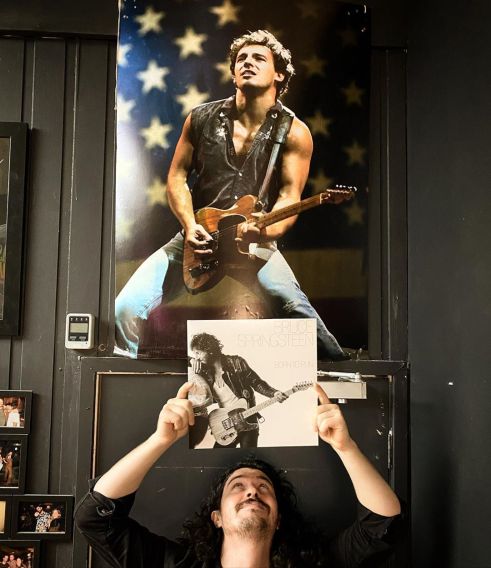
RECORD OF THE WEEK: BRUCE SPRINGSTEEN – BORN TO RUN (1974)

90091354_513544699593348_7317452006326753024_n

Born to Run is the record that made Springsteen into a bonafide star – like Kerouac and James Dean rolled into one, the Boss injects a cinematic sense of the romantic into this portrait of the working class Jersey Shore of 1974. Alive, in love and punch drunk on the possibilities of youth, freedom and rock n’ roll, the universal language of Born to Run makes you feel nostalgic for a world you have never known. Springsteen’s poetry and unflinching sincerity are so inscrutable that Born to Run doesn’t feel like a trope heavy concept album for a second – it possesses a strange quality that absolves you of cynicism the moment the needle drops, immersing you in tales of young love, tough guys, motorcycles and the American dream for thirty-nine minutes and twenty-three seconds. Scoring the festivities, of course, are the almighty E Street Band. Able to turn time to slow motion with the tap of a glockenspiel or make the hairs on your neck stand up with the rumble of Clarence Clemons’ iconic saxophone, the E Street Band flesh out Springsteen’s world and almost make it materialise before you. Born to Run is up there with Springsteen’s – or anybody’s – finest work. It doesn’t get much better than this! Just put it on your turntable, “roll down the window and let the wind blow back your hair. The night’s busted open. These two lanes will take us anywhere.”

RECORD OF THE WEEK: NEIL YOUNG – AFTER THE GOLD RUSH (1970)

88241656_844568839339447_6950205918607571008_n

After the Gold Rush sees Young develop further as a visionary songwriter after the rich successes of his previous LP Everybody Knows this is Nowhere. Although the simmering guitar jams of the previous LP return (Southern Man, When You Dance I Can Really Love), the heart of this record is in Young’s lyricism. Songs like the surreal title track and Don’t Let it Bring You Down highlight Young’s ability to blend darkness and light into the same lyric and see him shifting gears toward the more folk oriented Harvest. Only Love Can Break Your Heart is demonstrates Young’s gift for heart-string-pulling balladry and Southern Man with it’s condemnation of bigotry in America’s south earned itself a huge clap back in the form of Lynyrd Skynyrd’s Sweet Home Alabama. After the Gold Rush can be seen as a transition between the rockin’ Crazy Horse assisted Everybody Knows This is Nowhere and Harvest but I find it to be a perfect blend of the two, capturing Neil at his most creative and vital.

RECORD OF THE WEEK: THE ROLLING STONES – STICKY FINGERS (1971)

88200675_781385795603321_5376042718756844984_n

Of the Stones’ flawless series of records beginning with 1968’s Beggars Banquet and ending with the ragged excesses of 1972’s Exile on Main Street, there is a case to be made for Sticky Fingers as the Stones’ absolute peak. Cloaked in a druggy haze, Sticky Fingers saunters through a smorgasbord of the Stones’ hottest cuts, from the hot-footed Brown Sugar through soaring country opus Wild Horses, the Santana-inspired long form jam on Can’t You Hear Me Knocking, good natured country vamp Dead Flowers and the haunting album closer Moonlight Mile. Jimmy Miller’s production is both canny and spare and new guitarist Mick Taylor’s interplay with Keith Richards’ swashbuckling rhythm guitar allows the Stones’ songs to be ornate and dynamic in ways they never have before. Jagger, as always, plays the pouting ringmaster with his vocal approach shapeshifting from song to song, giving each a distinct feel. Sticky Fingers is a snapshot of the Stones at their most vital – a wildly creative pop culture phenomenon more than deserving of the mantel of the greatest rock and roll band in the world.

RECORD OF THE WEEK: LED ZEPPELIN – LED ZEPPELIN (1969)

84635145_168045391318546_5813489412341193573_n

The history of rock music can quite comfortably be divided into two categories – before Zeppelin I and after Zeppelin I! Although the undulating, sinuous heavy metal of this record is not without precedent, Hendrix and Cream in particular, Led Zep spawned a hard rock subculture that was quite seperate from the pop music of the time. It was subversive, sexual and anti establishment – listen to Robert Plant’s doom struck howl on Dazed and Confused or Jimmy Page’s savage riffing on Communication Breakdown – this record spoke to people on a primal level. That’s not to say that it’s without craftsmanship or nuance – the musicianship of each member speaks for itself. This record, and many of their later efforts, were critically panned by Rolling Stone, dismissing the songs as “weak and unimaginative” (look up the review, it is scathing!). Fifty years later and a million Rolling Stone covers later, I’m sure that writer never imagined the impact Zeppelin would have. This record was the beginning of a cultural phenomenon that is as potent today as it ever was.

RECORD OF THE WEEK: IGGY POP – LUST FOR LIFE (1977)

IggyReview

Iggy’s second Bowie-produced LP was cut in Berlin in 1977, the year that the punk wave that Iggy began with the Stooges years earlier had finally exploded. By the time Lust for Life came around, Iggy had grown beyond the scrappy Detroit punk that defined his early career and his sound had acquired an intellectual element that defied the violent primordialism of the Stooges. While Pop still rocks hard here on tracks like the eponymous Lust For Life (which became a hit many years later after its prominent use on the Trainspotting soundtrack), Sixteen and Some Weird Sin, there is an element of weary urban ennui in tracks like the Passenger and Turn Blue. This, combined with Bowie’s krautrock-inspired production and the pair’s obvious chemistry as songwriters, creates an album that plays to Iggy’s strengths – his showmanship and energy, but augments them with occasional vulnerability and pushes him into new sonic territory. Along with his previous album The Idiot, Lust For Life is Iggy’s finest solo offering and defined his sound and persona for the rest of his career.

RECORD OF THE WEEK: KINGS OF LEON – YOUTH AND YOUNG MANHOOD (2003)

82884180_845686149221581_1157202686971484448_n

Before their sex was on fire, Kings of Leon were a rag-tag bunch of southern brothers (and cousin) with a barnstorming southern rock flavoured debut record, Youth and Young Manhood. Slotting neatly into the guitar rock revival of the early 00’s alongside the White Stripes, the Hives and the Vines, the band found themselves affectionately dubbed “the Southern Strokes” by the rock press. While Youth and Young Manhood certainly doesn’t break any sonic ground, the band seem quite content not to reinvent the wheel, instead preferring to conjure a hip-shaking barn dance with the spectres of Tom Petty, the Allman Brothers and Creedence Clearwater Revival all looming largely. The Kings’ roughly hewn southern-rock charm would fade little by little on each subsequent album in favour of slick U2-sized balladry, but here on their debut they deliver a record that does exactly what it says on the box – a well crafted set of rock n’ roll tunes about self discovery and youthful indiscretion that, while proudly wearing its influences on its sleeve, is emotional, direct and electrifying.
Key tracks: Red Morning Light, Happy Alone

RECORD OF THE WEEK: PAUL KELLY – SONGS FROM THE SOUTH (2019)

74521304_515007679361100_6770537082127882718_n

Do you know what really gets my goat? Every bloody Christmas in Australia we’re inundated with “white Christmas” imagery from England and America while, in our own backyard, it’s hotter than a shearer’s armpit. As I write this, it’s 42 degrees outside and half the shops are covered in frosted snow flakes and reindeer. Wake up, Australia! So in the interest of further developing our national identity, for this week’s record I’ve selected Paul Kelly’s excellent new greatest hits anthology as a representation of his tear-jerker of an Aussie Christmas Carol, How to Make Gravy. Written from the perspective of an incarcerated man writing a letter home before Christmas, How to Make Gravy reads like a laundry list of Australian Christmas; Eating a roast in hundred degree heat? Check. Tomato sauce in the gravy for extra tang? Check. Your drunken uncle hitting on your girlfriend while you’re losing your mind in jail? Classic. And of course being a Paul Kelly song, his keen eye for detail, folksy charm and gift for communicating subtlety and emotional nuance all help to make this song a crown jewel in his ouvre.

RECORD OF THE WEEK: JEFF BUCKLEY – GRACE (1994)

73480714_1237991699745042_9154148361083208144_n

As I researched this review, I began to realise that everybody who I had spoken to had a very distinct visual memory of where they were the first time that they heard Grace – a memory they treated with the kind of reverence reserved for other coming-of-age milestones like their first kiss or the first time they got drunk. Grace radiates a strange spirituality, a special kind of magic that is difficult to explain. Central to its mystique is Jeff Buckley himself, the prodigious songbird who recorded just one record and died young a few years later, drowning in the Mississippi River. Jeff’s most potent gift, a feverish wail that could shift from breathy falsetto to siren-like howl with the ease of a bird taking flight, is the centrepiece of Grace. It’s a rare talent that can connect as deeply with a listener as Buckley does and as his tone shifts from choirboy to chanteuse to wailing rock god, a deep sense of intimacy prevails. At times, Buckley’s anguished cries give you the sense that he is suffering greatly, giving Grace an almost Passion-of-the-Christ-like quality that, coupled with his early death, contributes to the sacred, ethereal quality that permeates Grace.

RECORD OF THE WEEK: INXS – KICK (1987)

72678298_2568480006533406_3242584487237533147_n

INXS’ finally grabbed the brass ring of fully-fledged international pop stardom on their 6th LP “Kick.” After “What You Need”, the hit single from their previous record ”Listen Like Thieves” had stormed the international charts, the floodgates were wide open for Hutchence and co to make their mark on pop culture at large. Seemingly tailor-made for the MTV era with their innovative video clips, drop-dead-gorgeous frontman and shimmering brand of rock as much as home in the club as the pub, INXS were met by a surprising amount of resistance from Atlantic Records president Doug Morris who offered the band a million dollars to go and make a completely different record rather than release Kick. Thankfully, the band persisted and the label was dead wrong – Kick was a monster hit. “Need You Tonight”, “Devil Inside” and “New Sensation” hit 1, 2, and 3 respectively on the Billboard Charts and “Never Tear Us Apart” hit number 7. The the songwriting partner between Michael Hutchence and Andrew Farriss is in full effect here, yielding every one of the album’s 11 original songs. Kick overflows with swagger and has the chops to back it up. The crown jewel in INXS’ discography.

RECORD OF THE WEEK: AMY WINEHOUSE – BACK TO BLACK (2006)

75498658_173873903763663_8847627459463999071_n

In her sophomore record Amy Winehouse mines her own tumultuous private life for subject matter, penning eleven songs dominated by unflinching themes of addiction, grief and infidelity. On paper, this kind of thematic makeup would make for a rather melancholy album but somehow Back to Black is jubilant in spite of it. Winehouse’s infectious energy, half Michael Caine and half Billie Holliday, is in abundant supply, driving the keen wit and easy charm of her songwriting and the velvet sledgehammer of her distinctive croon. Production credits are split evenly between Saalam Remi and Mark Ronson who painstakingly collage the history of soul music from the Ronettes to Mary J Blige without sounding completely derivative, managing to create a record that sounds fresh rather than an exercise in soul-revivalism. Sharon Jones’ band, the legendary Dap-Kings are on loan here and are, as always, on point. Listening to Back to Black in hindsight after Amy’s death in 2011, it’s hard not to see a lot of foreshadowing in the songs on this record. It is a testament to her skill that she was able to deal with such darkness in a way that brought light to so many.