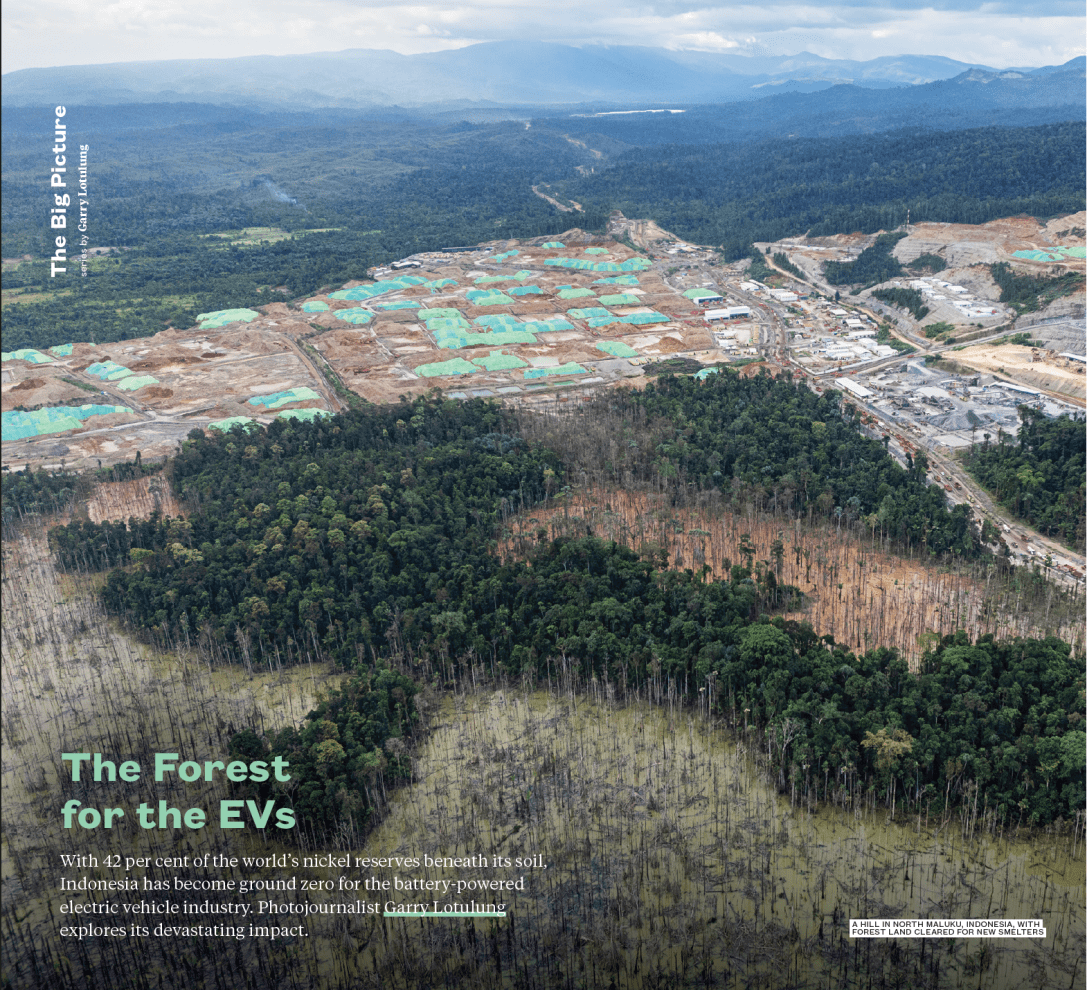
Garry Lotulung moves through the verdant jungle of Indonesia’s volcanic Halmahera island – a drone strapped across his back, a camera swinging from his neck. By his side, a local fixer leads the way. The two men are searching for the Hongana Manyawa, an Indigenous tribe whose forest home is being carved apart for nickel – the semi-precious metal is a key component of the batteries powering the burgeoning electric vehicle industry.
“My intention is to help the subjects of this work – this community, the Indigenous tribes, the fishermen, the farmers, the people living near the smelters,” Lotulung says of his photo essay Nickel for EVs Threatens Key Forests and the Last Nomadic Tribes in Indonesia. “The coal and smelting plants have polluted the air and water. From the sea, you can even see the air pollution and the change in water colour, from blue to yellow. So many farmers’ crops have failed due to declining soil and water quality.”
The Hongana Manyawa have depended on the forests of Halmahera for generations. A group of between 300 and 500 are uncontactable, according to Survival International, living in what the mining companies describe as “voluntary isolation”.
“It took maybe four or five days, starting from the Dodaga area, walking around the forest, to find the community,” Lotulung recalls. When he finally arrived, he was met with suspicion. “One of the families rejected me because I was carrying a camera and a drone. They thought I was with the mining companies… They are very afraid of the companies, who send workers to threaten them. The community is forced to keep moving.”
Mining, nickel smelting and the construction of 12 coal power plants have eradicated much of the vegetation on the island, leaving it prone to flash flooding. On Lotulung’s second day in the Weda Bay mining area, heavy rain triggered a flood that submerged seven villages, destroying plantations and sweeping houses away. “Previously, rain might cause flooding for maybe just three or four hours,” he notes. “But because they are destroying the forest in this area, the flooding now comes quickly to the villages.” He waded through waterlogged farmland for two days, photographing residents like farmer Adrian Patapata standing calf-deep in mud, swinging a machete, trying to salvage what he could of his ruined cocoa crop.
Lotulung took a guerrilla approach to documenting PT Weda Bay Nickel mining operation at the Indonesia Weda Bay Industrial Park. Guided by local NGOs, he studied guard patrol schedules and scouted safe vantage points to launch his drone undetected. “If I had asked for official permission, they would likely have followed my car, and it would have created more problems for my work,” he explains.
As garages fill with electric vehicles all over the world, the staggering images Lotulung captured on Halmahera remind us that progress has a price. “Photographs can only remind us of what has happened,” Lotulung says. “If I’ve done my job properly, the images I produce can convey empathy and concern. Then it is up to those who wield power, the government, to implement their policies.”
VISIT GARRYLOTULUNG.COM FOR MORE.
 Pete Whelan