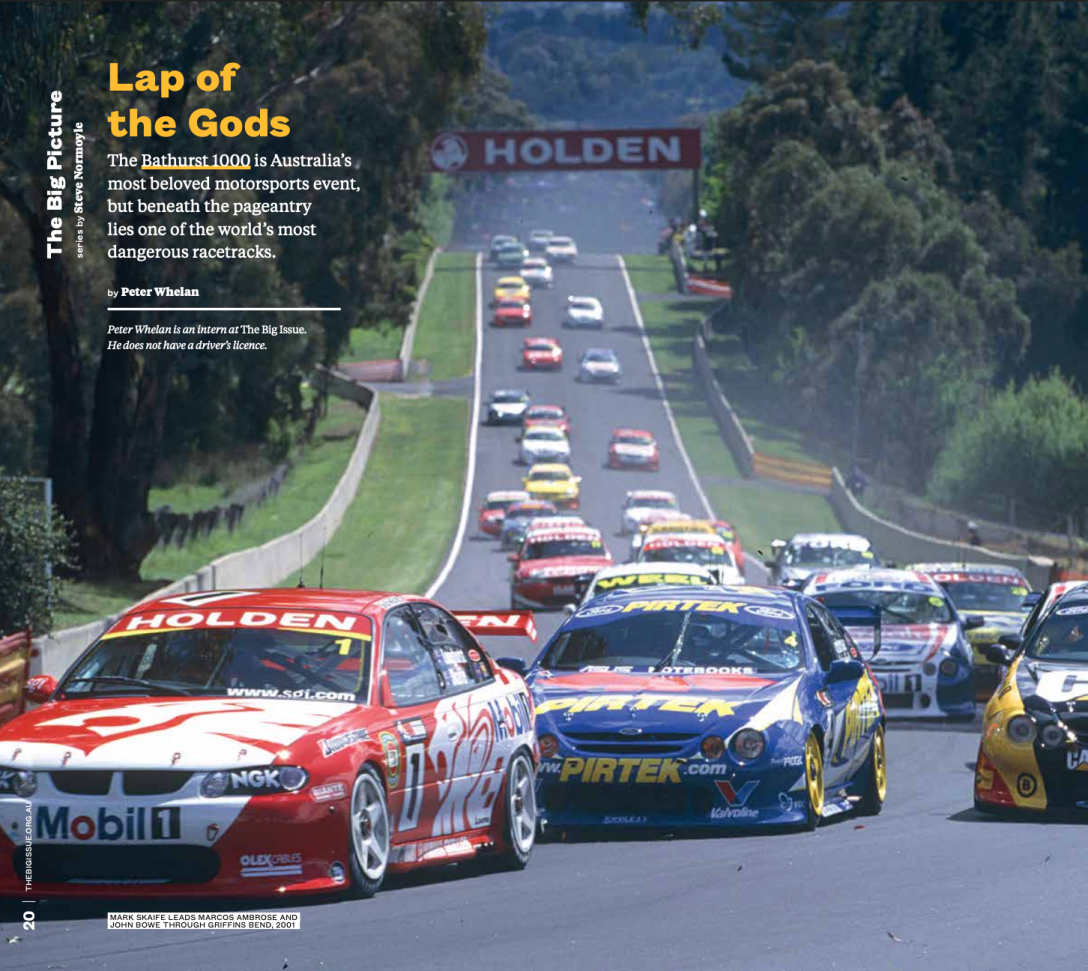
The Bathurst 1000 is Australia’s most beloved motorsports event, but beneath the pageantry lies one of the world’s most dangerous racetracks.
Much has changed over the 60 years of the Bathurst 1000. Once a testing ground for unmodified sedans from car dealerships, the track now swarms each October with V8 Supercars emblazoned with corporate logos. They hurtle along the winding road at speeds in excess of 200 kilometres an hour. Since day one, though, the summit of Mount Panorama in the NSW town has quietly presided over the squealing tires and photo finishes – its sharp hills and hairpin bends at the heart of one of the world’s most unique motorsport events.
“It’s an extreme place,” says Steve Normoyle, author of Bathurst: 60 Years of the Great Race. The photo-driven chronicle documents the 161-lap race’s “many tales of triumph and tragedy” over the years. There’s Peter Brock’s staggering 1979 win, which saw him and Jim Richards place six laps ahead of their nearest competitor. Also featured is Richards’ controversial win in 1992, when torrential rain and numerous crashes – including one involving Richards’ leading Nissan GT-R – caused the race to be stopped and the clock wound back. Perhaps mercifully, however, all images of David Reynolds swilling champagne from a shoe after his 2017 victory have been omitted.
“If I ever won Bathurst, there wouldn’t be a shoey,” Normoyle laughs. Despite these moments of levity, Bathurst is not for the faint of heart. “If you built that track today and tried to use it for car racing, the authorities would laugh at you. It would be considered too dangerous on all sorts of levels,” says Normoyle of the 1000km track. “The drivers themselves all talk about it being the only place where one of their competitors is the circuit itself. You don’t need to be a motorsport enthusiast to watch it and understand just how difficult it is.”
Normoyle says the “sheer elevation change, the run across the top of the mountain, the drop off the end, and the long run down Conrod Straight” make the track so risky. “In the early days, there were no fences around the top,” he explains, “so if a car crashed off the inside of the circuit, it often rolled down the mountain. It was very much frontier stuff.” The challenges for the drivers aren’t limited to the difficulty of the track – they must also contend with Mount Panorama itself. One of the mountain’s more famous interventions in the race came in 1980, when driver Dick Johnson’s iconic “TRUBLU” Ford Falcon XD struck an errant rock on the track. “In one of the 12-hour races one year, there was a lot of rain,” says Normoyle.
“During the race, a tree on the inside of the circuit fell across the track. I don’t think that’s ever happened at any motorsport event in the world. “Ironically,” he adds, “it’s probably one of the safer tracks for a photographer.” The elevation allows viewpoints that other tracks could not accommodate. The images Normoyle has compiled tell a story so vivid, you can almost smell the engine oil and burnt rubber.
But after poring over thousands of photos in the archives, the photographer has yet to decide on his favourite. “If you ask me, any picture of a car at Mount Panorama is worth looking at,” he says with the air of a man who loves his job.
 Pete Whelan