“There was nothing but the Kazakh Steppe all around us – grassland that just goes on for ever and ever. It’s almost like the sea. We were driving on a tiny little road that slowly started to disappear until it was actually gone,” says Canadian photographer Christopher Herwig. “All the grass was just kind of standing up behind us, and we realised we didn’t know where the road was anymore. For about an hour, we panicked. We didn’t know whether to go north, south, east or west – it was as if we were in a boat in the middle of the ocean.” Eventually, Herwig found what he had been searching for: a strange angular structure of faded white concrete that brings to mind a dog sitting obediently, nestled in the Steppe’s yellow grass. It was a bus stop.
Located in Taraz, Kazakhstan, this example is one of hundreds that Herwig, self-professed bus stop hunter, has documented since 2002 as part of his Soviet Bus Stops project, spanning over 50,000 kilometres and 15 former Soviet countries.
Herwig stumbled across the first by happenstance, cycling from London to St Petersburg. “You think of these things you want to photograph in terms of iconic monuments, or images, but you’re working your butt off on the bike and things are flying by, and it’s never the perfect National Geographic photograph moment,” Herwig says. “So, on this trip I decided I wanted to just photograph ordinary things to get the creative juices flowing, so to speak.”
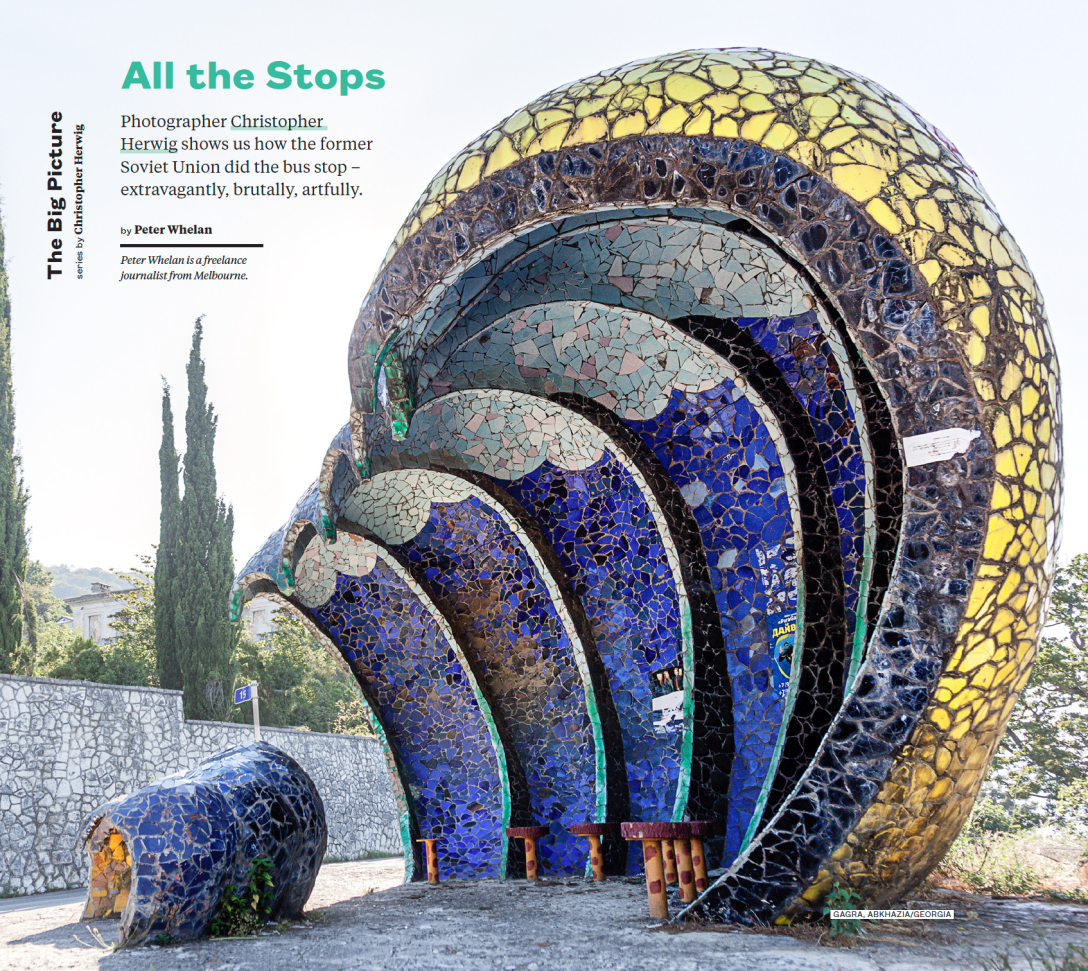
Crossing into Eastern Europe, Herwig noticed that “stuff started popping up on these little country roads,” bizarre bus stops that he soon realised were littered throughout each of the former Soviet republics. Among them were jagged brutalist structures in Armenia, intricate Gaudí-esque mosaics in Ukraine, and multi-limbed retro-futuristic monstrosities in Estonia. Each, while unique, defied the utilitarian prefabricated concrete aesthetic typical of the Soviet era’s state-sanctioned architecture. Herwig found himself poised at the intersection of the mundane he initially sought, and the fantastical. “These were really extraordinary,” Herwig says. “They were ordinary, but extraordinary.”
Bus stops were classified under the lowest tier of Soviet public infrastructure, able to fly under the radar of the Soviet Union’s rigid design guidelines. “A big part of how it started was George Chakhava,” Herwig says of the Georgian architect responsible for some of the earliest bus stops. “He was the Deputy Minister of the Ministry of Automobile Roads, but he was also an architect, and an artist, and he actually commissioned himself. After that point, you see a lot of other artists inspired by his creativity.”
Twenty-two years, three books and one documentary later, Herwig has collected stories from communities that house many of the bus stops. “In Estonia, this group of factory workers just needed a shelter because there was a bus coming. But this thing looks like a spider – it’s got quite a number of legs. I asked them, ‘Did this design come from the state? Were you encouraged to make this interesting?’ And the answer was, ‘No, we just wanted a bus stop. No-one told us to do this. We just did it.’” But, in the creatively suppressed environment, Herwig says, “The important thing is that no-one told them not to do it, either.”
FOR MORE, VISIT HERWIGPHOTO.SMUGMUG.COM.
 Pete Whelan