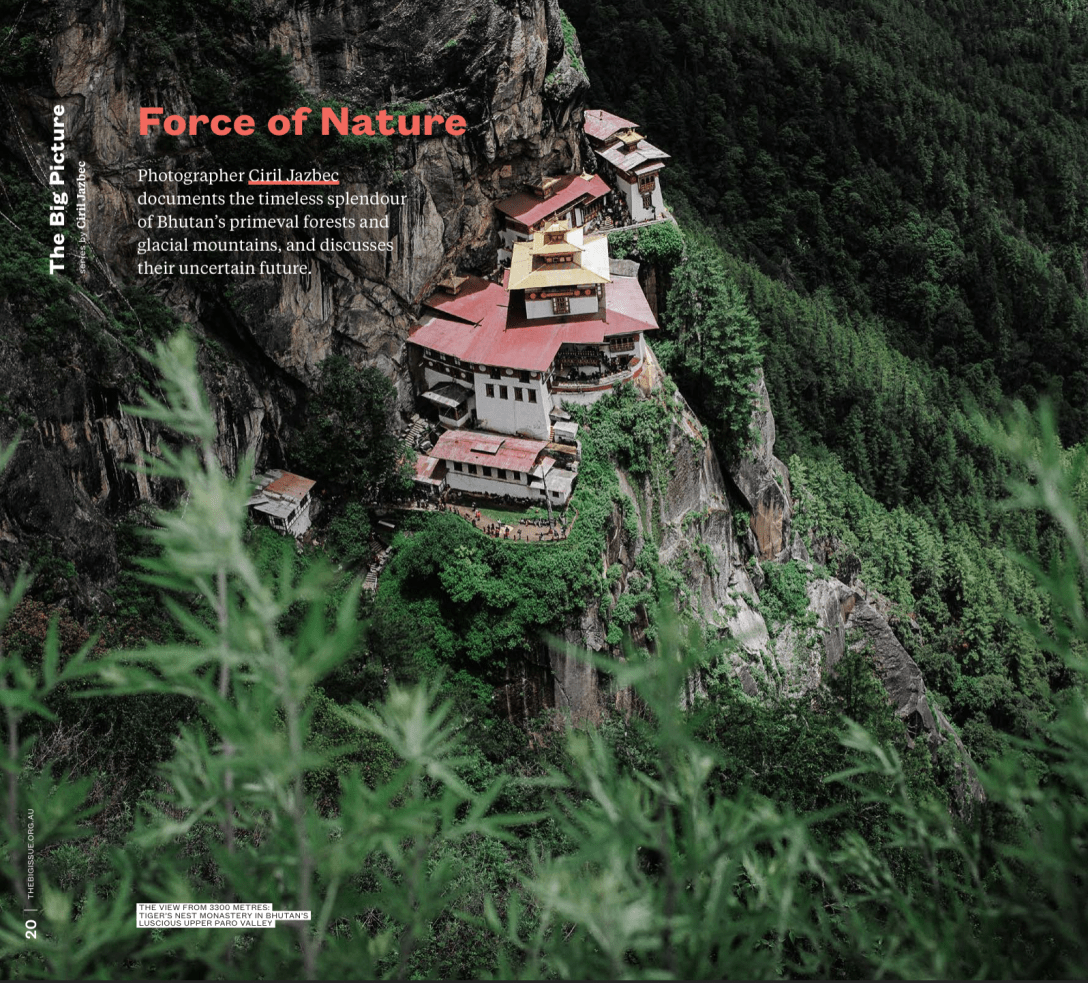
Photographer Ciril Jazbec documents the timeless splendour of Bhutan’s primeval forests and glacial mountains, and discusses their uncertain future.
In a world beset by a reluctance to tackle global warming, the ancient wilds of Bhutan are a breath of fresh air, literally. This tiny kingdom on the eastern edge of the Himalayas is one of the few countries on Earth that is not just carbon neutral, but carbon negative.
“Bhutan is a carbon sink,” says photographer Ciril Jazbec. He was inspired to travel to Bhutan when he discovered their constitutional commitment to keeping 60 per cent of land as permanent forest. “The nature is magnificent. I was amazed by their vast forests and the variety of plants, so naturally I was trying to find a small community that would reflect all that. Laya seemed to be the one.”
Located in Jigme Dorji National Park, Laya is a peaceful village by the Tibetan border, nestled in the foothills of the Tsenda Kang mountain, its glaciated peak piercing the low-hanging mist that lingers over many of Jazbec’s subjects. “Reaching Laya took three very long days of trekking,” the Slovenian photographer says. “It felt like entering another planet where time has stopped, and you feel very grateful to have the opportunity to be there.”
Largely informed by its mostly Buddhist population, Bhutan’s coexistence with its thriving ecosystem is symbiotic. More than two-thirds of the country is protected as national park, nature reserve or wildlife sanctuary, and a network of biological corridors has been established between each to allow wildlife free rein across the country. And while it’s not illegal to consume meat in the largely vegetarian nation, it’s all imported, as the butchering of animals for consumption is banned.
“I saw many white horses roaming through remote settlements,” Jazbec says. “And I rarely saw animals tied up. When people need to use them, they’ll just climb the mountains to find them. There’s something special about their relationship with nature and all living beings. For instance, I once tried to get rid of a fly on the screen of my laptop in the evening and my fixer [the local guides who accompany tourists to the region] almost started to cry.”
Green though it may be, Bhutan has begun to feel the effects of the planet’s changing climate. In recent years, Jazbec says, the country has been subject to shrinking glaciers and water reservoirs, as well as flash floods and landslides. “[It’s] forcing the nomadic people of the remote settlements in the Eastern Himalaya to adapt to survive,” he says. “These yak-herding pastoralists live among the glaciers and migrate to lower altitudes every winter.”
Bhutan’s government has responded by stressing the importance of sustainable buildings, electric vehicles and a high-value, low-impact tourism strategy to ease the burden the country’s ecosystem and, by extension, its way of life.
During Jazbec’s travels, he followed and lived with Tshering, a yak herder whose ongoing relationship with the land provides a stark perspective on Bhutan’s changing environment. “His camp is located right next to the glacier,” Jazbec says. “He showed me how the glacier has shrunk in the last few years. He’s worried what might happen when the glacier finally melts.”
SEE MORE OF CIRIL JAZBEC’S WORK AT CIRILJAZBEC.COM.
 Pete Whelan