The Big Issue: Finger Fights

 In the dim glow of a carpentry workshop in Ohlstadt, Bavaria, Josef Utzschneider attaches a 51-kilo cement block to a pulley system and lifts it, using only his middle finger, as if it were a bag of groceries. “I remember watching him do it and thinking that it seemed like nothing to him,” recalls Munich-based photographer Angelika Jakob of Utzschneider’s training for the German Finger Wrestling Championship. 

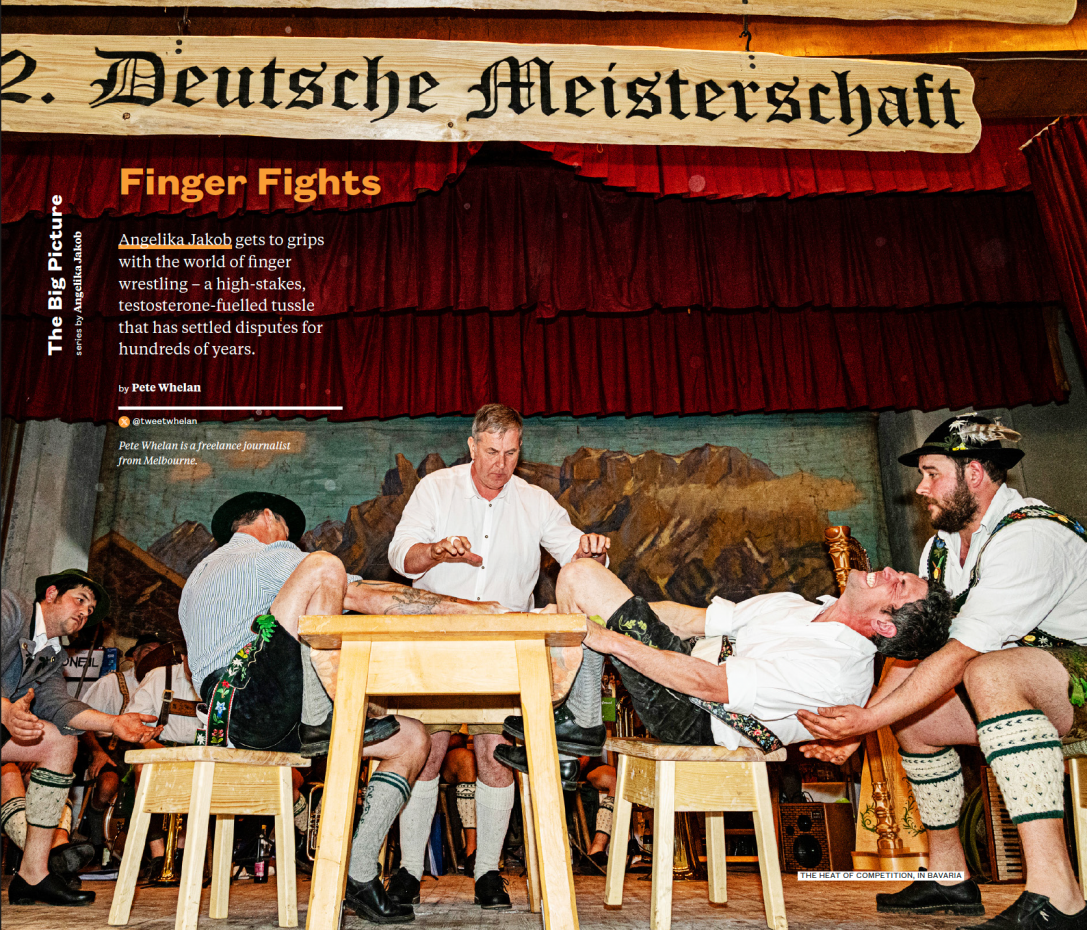
The rules of finger wrestling (known locally as fingerhakeln) are simple. When the referee yells “Zieht!” you pull until either you or your opponent succeeds in dragging the other’s finger across their edge of the table. It’s like a tug of war, on a small scale. A typical match lasts about 10 seconds. Utzschneider, once called the “Usain Bolt of finger wrestling” by the Süddeutsche Zeitung (one of Germany’s largest daily newspapers), has been known to finish his opponents in under two.

Each time Utzschneider hooks his enormous finger through the leather loop used to bind him to his opponents, he carries his family legacy on his broad palms. His father was a champion, his grandfather was a champion, his great-grandfather was a champion, and he is a champion – many times over. He tells Jakob that genetics are key – big, strong hands run in the family. “Family tradition on the one hand, physiognomy on the other. Luckily, he is careful when he shakes hands,” she adds. “Otherwise, he could have crushed me.”

Sometimes there are injuries. “People bleed,” confides Jakob, “But they [the finger wrestling community] don’t like it to be mentioned. That kind of publicity is not good for the sport, so I stayed away from that, and I think they appreciated it.” Instead, Jakob stood back and observed, earning the competitors’ acceptance when they understood she was not there to poke fun at their passion. “In a situation like that, it’s important not to ask too many stupid questions,” she reflects. “Better to just let them do their thing.” 

Finger wrestling is said to have its roots in the 14th century, when it was used to settle disputes in the Alpine region. Now it’s an organised sport, with the annual German Finger Wrestling Championship the main event. Men and boys clad in traditional Lederhosen fill the long wooden tables, lined with pork and steaming dumplings. At last year’s festival there were 163 competitors across 440 matches starting at 10am – with regular beer breaks, of course. “The atmosphere was a mixture of tension and fun – it’s like a soccer game, with the amount of investment from the audience – they take it very seriously, but it’s fun, too,” Jakob says. “It’s mostly only men in attendance. It’s a man thing,” she adds. 

In the end, Utzschneider walked away with another victory. “They don’t do it for the prizes,” Jakob says. “They do it for fame and honour. Being a champion of finger wrestling bestows a revered status in their village – it’s a badge of recognition from their community.” 

FOR MORE, VISIT ANGELIKAJAKOB.COM. 
The Big Issue: In Good Hands

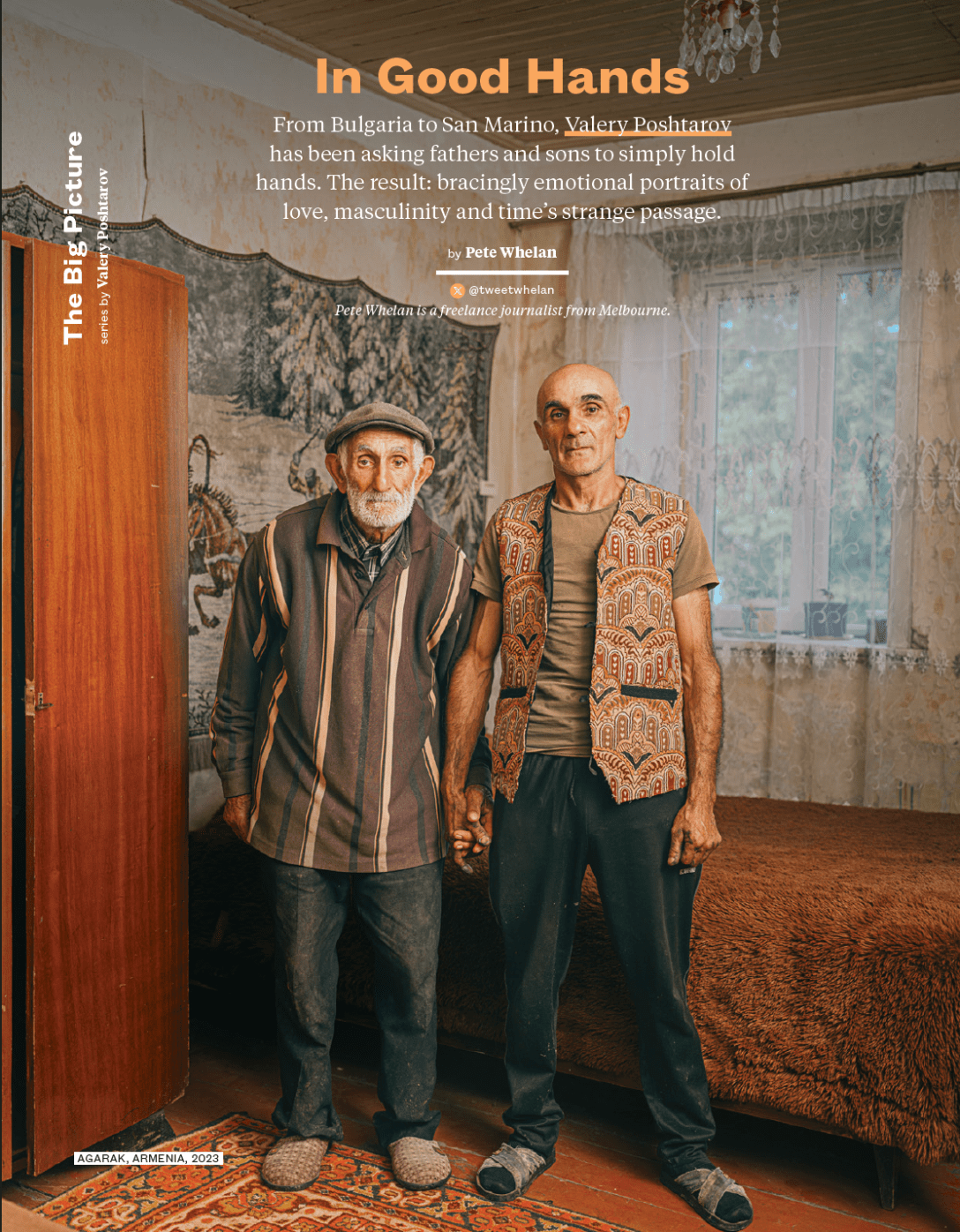
 Imagine a stranger approaching you in your home town and asking you to hold hands with your father or son for a photograph. It’s a simple request, but one that can carry an unexpected weight – one that Bulgarian photographer Valery Poshtarov has spent the last four years unpacking. In his ongoing series Father and Son, Poshtarov has travelled across 11 countries, capturing hundreds of these moments between adult men: sometimes tender, sometimes awkward, and often revealing. 

Poshtarov steps into strangers’ lives – in wheat factories, garages or even priests’ homes – and asks them to hold hands. “I’m just a facilitator, I try to preserve the authenticity of the moment,” he says. The results can be unpredictable, but they are always real. “You never know how it will develop because this is something that may not happen again in their lifetime. Sometimes, this is the first time that it’s happening.” 

Father and Son is a heartwarming tribute to the frequently unspoken, patriarchal bond, but there is another side to that coin. “There are instances where one of the participants just refused to hold the hand of the other,” he says. “Sometimes I felt guilty about it, because I had initiated it. But on the other hand, I realised that although the experience was painful, it was also something thought-provoking that could lead to a re-evaluation of their connection.” 

These moments of discomfort reflect the deeper emotional currents that Father and Son gently confronts. The unease some men feel when asked to hold hands stems not just from personal discomfort, but also from the weight of cultural norms that discourage such intimacy. “Society has built taboos around men’s emotional expression,” Poshtarov explains. “When I ask them to hold hands, I’m overriding those expectations, asking them to show their togetherness. Even if there’s frustration, it’s important to keep it. It’s authentic.” 

The catalyst for Father and Son was Poshtarov’s relationship with his own sons. “I have two sons, and I used to walk them to school holding their hands,” he says. “I wanted to prove myself wrong – that this connection wouldn’t fade away.” He wanted to apply the same simple, meaningful gesture he shared with his sons to his father and grandfather, but the pandemic delayed that plan. Poshtarov’s grandfather was 96 and frail, so he began with others instead, finally getting the shot a few months before the older man’s passing. 

“This is the only photo they have together, just the two of them,” Poshtarov says. “It was very special to me, because my grandfather at that point was an elderly man. To see the way my father held his hand, there were so many different things in there. Recognition, support, willingness to help him – all in one image. You can see a whole life brought together by two generations. The past in the future. It’s like the circle of life.” 


 FOR MORE, GO TO POSHTAROV.NET. 

The Big Issue: All The Stops

 “There was nothing but the Kazakh Steppe all around us – grassland that just goes on for ever and ever. It’s almost like the sea. We were driving on a tiny little road that slowly started to disappear until it was actually gone,” says Canadian photographer Christopher Herwig. “All the grass was just kind of standing up behind us, and we realised we didn’t know where the road was anymore. For about an hour, we panicked. We didn’t know whether to go north, south, east or west – it was as if we were in a boat in the middle of the ocean.” Eventually, Herwig found what he had been searching for: a strange angular structure of faded white concrete that brings to mind a dog sitting obediently, nestled in the Steppe’s yellow grass. It was a bus stop. 

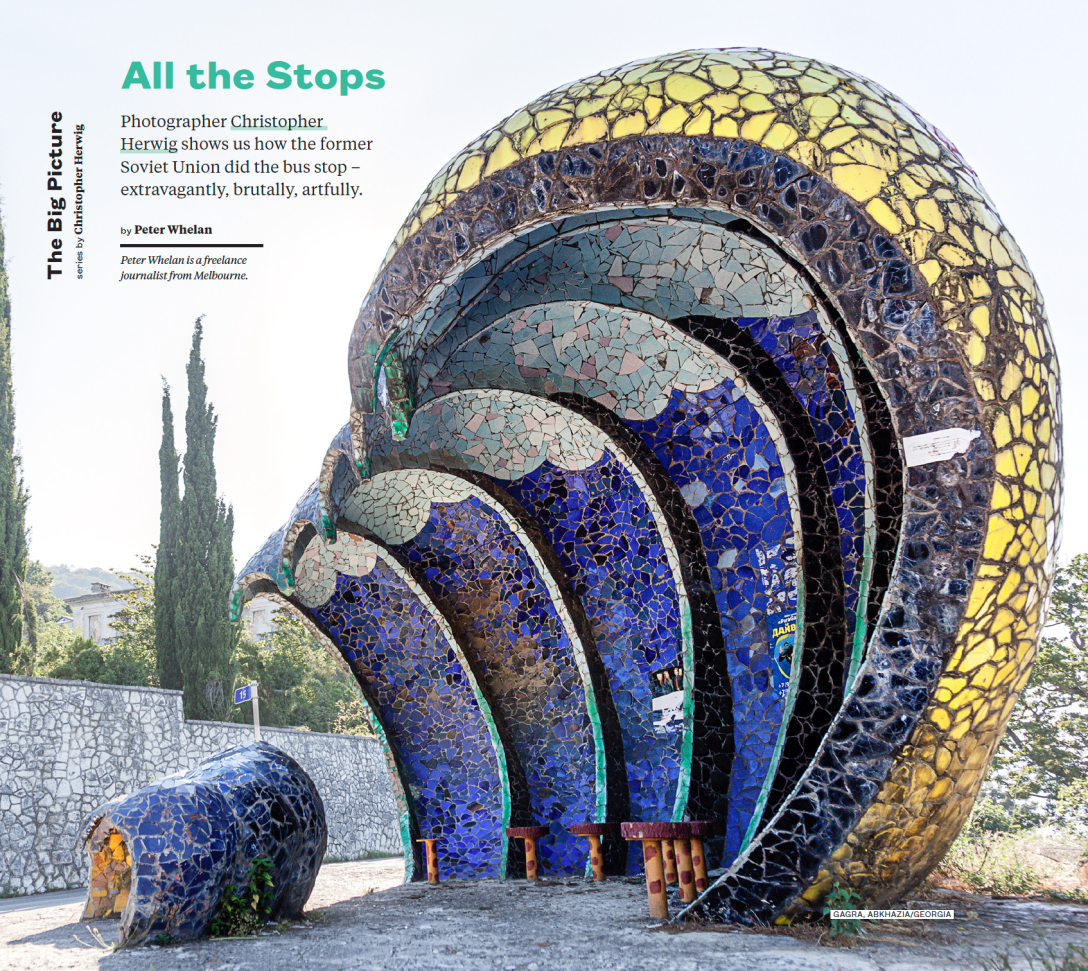
Located in Taraz, Kazakhstan, this example is one of hundreds that Herwig, self-professed bus stop hunter, has documented since 2002 as part of his Soviet Bus Stops project, spanning over 50,000 kilometres and 15 former Soviet countries. 

Herwig stumbled across the first by happenstance, cycling from London to St Petersburg. “You think of these things you want to photograph in terms of iconic monuments, or images, but you’re working your butt off on the bike and things are flying by, and it’s never the perfect National Geographic photograph moment,” Herwig says. “So, on this trip I decided I wanted to just photograph ordinary things to get the creative juices flowing, so to speak.” 

Crossing into Eastern Europe, Herwig noticed that “stuff started popping up on these little country roads,” bizarre bus stops that he soon realised were littered throughout each of the former Soviet republics. Among them were jagged brutalist structures in Armenia, intricate Gaudí-esque mosaics in Ukraine, and multi-limbed retro-futuristic monstrosities in Estonia. Each, while unique, defied the utilitarian prefabricated concrete aesthetic typical of the Soviet era’s state-sanctioned architecture. Herwig found himself poised at the intersection of the mundane he initially sought, and the fantastical. “These were really extraordinary,” Herwig says. “They were ordinary, but extraordinary.” 

Bus stops were classified under the lowest tier of Soviet public infrastructure, able to fly under the radar of the Soviet Union’s rigid design guidelines. “A big part of how it started was George Chakhava,” Herwig says of the Georgian architect responsible for some of the earliest bus stops. “He was the Deputy Minister of the Ministry of Automobile Roads, but he was also an architect, and an artist, and he actually commissioned himself. After that point, you see a lot of other artists inspired by his creativity.” 

Twenty-two years, three books and one documentary later, Herwig has collected stories from communities that house many of the bus stops. “In Estonia, this group of factory workers just needed a shelter because there was a bus coming. But this thing looks like a spider – it’s got quite a number of legs. I asked them, ‘Did this design come from the state? Were you encouraged to make this interesting?’ And the answer was, ‘No, we just wanted a bus stop. No-one told us to do this. We just did it.’” But, in the creatively suppressed environment, Herwig says, “The important thing is that no-one told them not to do it, either.” 

 FOR MORE, VISIT HERWIGPHOTO.SMUGMUG.COM.