The Big Issue: Finger Fights

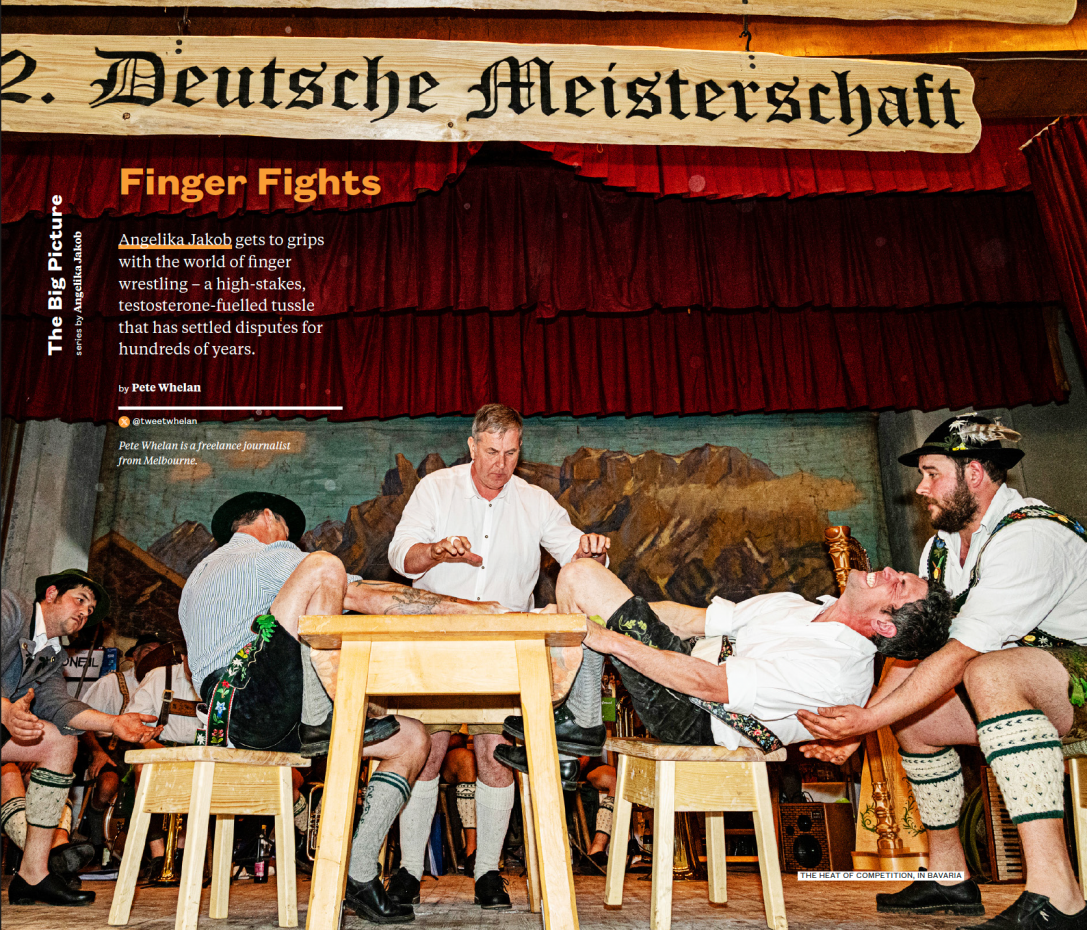
 In the dim glow of a carpentry workshop in Ohlstadt, Bavaria, Josef Utzschneider attaches a 51-kilo cement block to a pulley system and lifts it, using only his middle finger, as if it were a bag of groceries. “I remember watching him do it and thinking that it seemed like nothing to him,” recalls Munich-based photographer Angelika Jakob of Utzschneider’s training for the German Finger Wrestling Championship. 

The rules of finger wrestling (known locally as fingerhakeln) are simple. When the referee yells “Zieht!” you pull until either you or your opponent succeeds in dragging the other’s finger across their edge of the table. It’s like a tug of war, on a small scale. A typical match lasts about 10 seconds. Utzschneider, once called the “Usain Bolt of finger wrestling” by the Süddeutsche Zeitung (one of Germany’s largest daily newspapers), has been known to finish his opponents in under two.

Each time Utzschneider hooks his enormous finger through the leather loop used to bind him to his opponents, he carries his family legacy on his broad palms. His father was a champion, his grandfather was a champion, his great-grandfather was a champion, and he is a champion – many times over. He tells Jakob that genetics are key – big, strong hands run in the family. “Family tradition on the one hand, physiognomy on the other. Luckily, he is careful when he shakes hands,” she adds. “Otherwise, he could have crushed me.”

Sometimes there are injuries. “People bleed,” confides Jakob, “But they [the finger wrestling community] don’t like it to be mentioned. That kind of publicity is not good for the sport, so I stayed away from that, and I think they appreciated it.” Instead, Jakob stood back and observed, earning the competitors’ acceptance when they understood she was not there to poke fun at their passion. “In a situation like that, it’s important not to ask too many stupid questions,” she reflects. “Better to just let them do their thing.” 

Finger wrestling is said to have its roots in the 14th century, when it was used to settle disputes in the Alpine region. Now it’s an organised sport, with the annual German Finger Wrestling Championship the main event. Men and boys clad in traditional Lederhosen fill the long wooden tables, lined with pork and steaming dumplings. At last year’s festival there were 163 competitors across 440 matches starting at 10am – with regular beer breaks, of course. “The atmosphere was a mixture of tension and fun – it’s like a soccer game, with the amount of investment from the audience – they take it very seriously, but it’s fun, too,” Jakob says. “It’s mostly only men in attendance. It’s a man thing,” she adds. 

In the end, Utzschneider walked away with another victory. “They don’t do it for the prizes,” Jakob says. “They do it for fame and honour. Being a champion of finger wrestling bestows a revered status in their village – it’s a badge of recognition from their community.” 

FOR MORE, VISIT ANGELIKAJAKOB.COM. 

The Big Issue: The Forest for the EVs

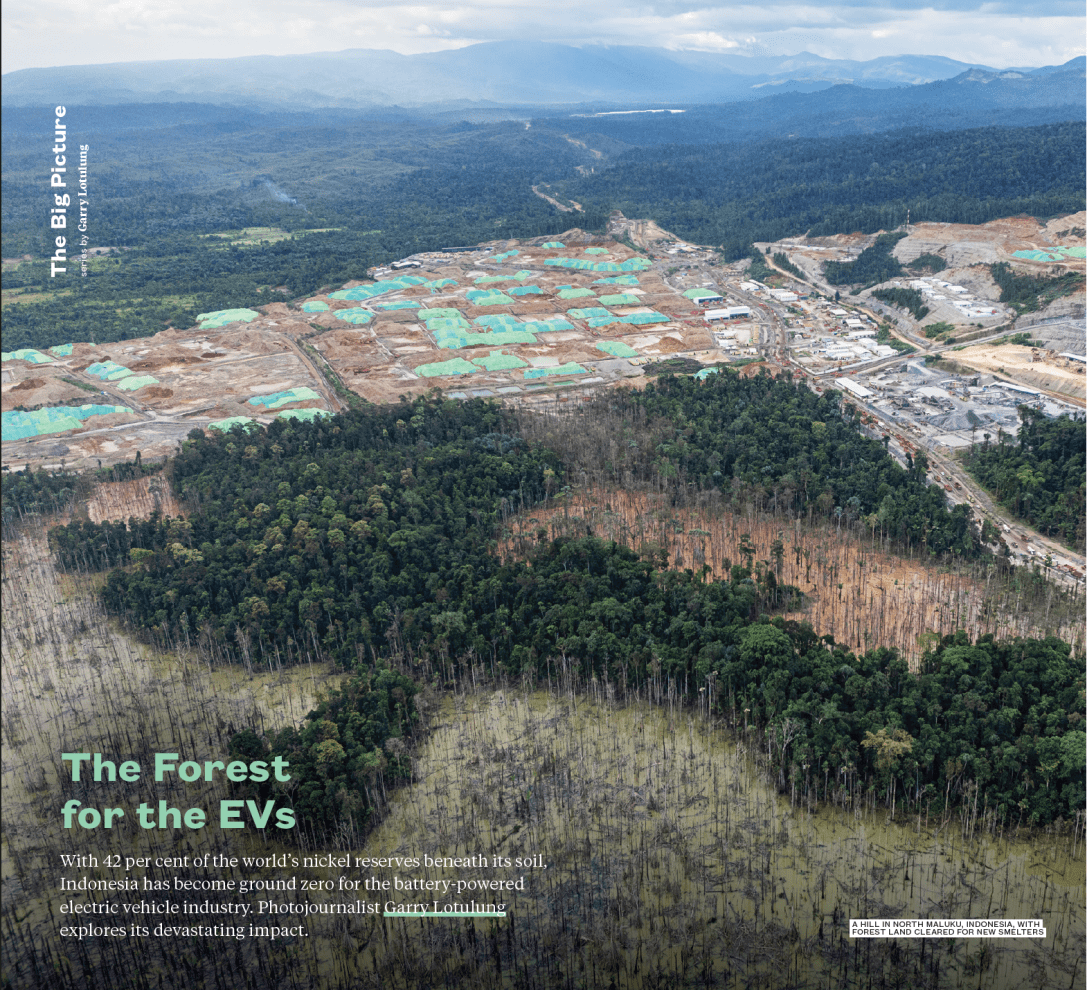
 Garry Lotulung moves through the verdant jungle of Indonesia’s volcanic Halmahera island – a drone strapped across his back, a camera swinging from his neck. By his side, a local fixer leads the way. The two men are searching for the Hongana Manyawa, an Indigenous tribe whose forest home is being carved apart for nickel – the semi-precious metal is a key component of the batteries powering the burgeoning electric vehicle industry. 

“My intention is to help the subjects of this work – this community, the Indigenous tribes, the fishermen, the farmers, the people living near the smelters,” Lotulung says of his photo essay Nickel for EVs Threatens Key Forests and the Last Nomadic Tribes in Indonesia. “The coal and smelting plants have polluted the air and water. From the sea, you can even see the air pollution and the change in water colour, from blue to yellow. So many farmers’ crops have failed due to declining soil and water quality.” 

The Hongana Manyawa have depended on the forests of Halmahera for generations. A group of between 300 and 500 are uncontactable, according to Survival International, living in what the mining companies describe as “voluntary isolation”. 

“It took maybe four or five days, starting from the Dodaga area, walking around the forest, to find the community,” Lotulung recalls. When he finally arrived, he was met with suspicion. “One of the families rejected me because I was carrying a camera and a drone. They thought I was with the mining companies… They are very afraid of the companies, who send workers to threaten them. The community is forced to keep moving.” 

Mining, nickel smelting and the construction of 12 coal power plants have eradicated much of the vegetation on the island, leaving it prone to flash flooding. On Lotulung’s second day in the Weda Bay mining area, heavy rain triggered a flood that submerged seven villages, destroying plantations and sweeping houses away. “Previously, rain might cause flooding for maybe just three or four hours,” he notes. “But because they are destroying the forest in this area, the flooding now comes quickly to the villages.” He waded through waterlogged farmland for two days, photographing residents like farmer Adrian Patapata standing calf-deep in mud, swinging a machete, trying to salvage what he could of his ruined cocoa crop. 

Lotulung took a guerrilla approach to documenting PT Weda Bay Nickel mining operation at the Indonesia Weda Bay Industrial Park. Guided by local NGOs, he studied guard patrol schedules and scouted safe vantage points to launch his drone undetected. “If I had asked for official permission, they would likely have followed my car, and it would have created more problems for my work,” he explains. 

As garages fill with electric vehicles all over the world, the staggering images Lotulung captured on Halmahera remind us that progress has a price. “Photographs can only remind us of what has happened,” Lotulung says. “If I’ve done my job properly, the images I produce can convey empathy and concern. Then it is up to those who wield power, the government, to implement their policies.” 

VISIT GARRYLOTULUNG.COM FOR MORE. 

The Big Issue: In Good Hands

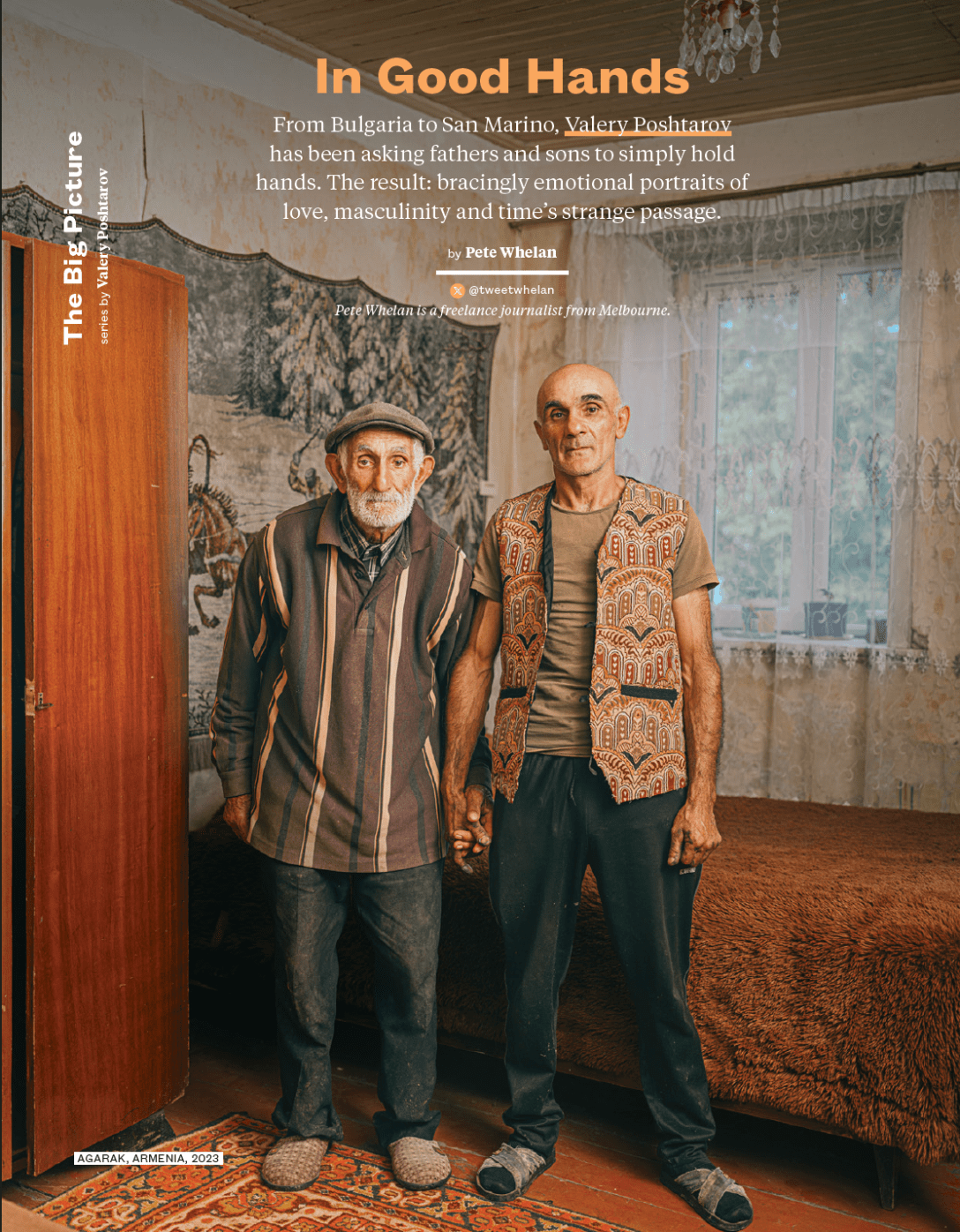
 Imagine a stranger approaching you in your home town and asking you to hold hands with your father or son for a photograph. It’s a simple request, but one that can carry an unexpected weight – one that Bulgarian photographer Valery Poshtarov has spent the last four years unpacking. In his ongoing series Father and Son, Poshtarov has travelled across 11 countries, capturing hundreds of these moments between adult men: sometimes tender, sometimes awkward, and often revealing. 

Poshtarov steps into strangers’ lives – in wheat factories, garages or even priests’ homes – and asks them to hold hands. “I’m just a facilitator, I try to preserve the authenticity of the moment,” he says. The results can be unpredictable, but they are always real. “You never know how it will develop because this is something that may not happen again in their lifetime. Sometimes, this is the first time that it’s happening.” 

Father and Son is a heartwarming tribute to the frequently unspoken, patriarchal bond, but there is another side to that coin. “There are instances where one of the participants just refused to hold the hand of the other,” he says. “Sometimes I felt guilty about it, because I had initiated it. But on the other hand, I realised that although the experience was painful, it was also something thought-provoking that could lead to a re-evaluation of their connection.” 

These moments of discomfort reflect the deeper emotional currents that Father and Son gently confronts. The unease some men feel when asked to hold hands stems not just from personal discomfort, but also from the weight of cultural norms that discourage such intimacy. “Society has built taboos around men’s emotional expression,” Poshtarov explains. “When I ask them to hold hands, I’m overriding those expectations, asking them to show their togetherness. Even if there’s frustration, it’s important to keep it. It’s authentic.” 

The catalyst for Father and Son was Poshtarov’s relationship with his own sons. “I have two sons, and I used to walk them to school holding their hands,” he says. “I wanted to prove myself wrong – that this connection wouldn’t fade away.” He wanted to apply the same simple, meaningful gesture he shared with his sons to his father and grandfather, but the pandemic delayed that plan. Poshtarov’s grandfather was 96 and frail, so he began with others instead, finally getting the shot a few months before the older man’s passing. 

“This is the only photo they have together, just the two of them,” Poshtarov says. “It was very special to me, because my grandfather at that point was an elderly man. To see the way my father held his hand, there were so many different things in there. Recognition, support, willingness to help him – all in one image. You can see a whole life brought together by two generations. The past in the future. It’s like the circle of life.” 


 FOR MORE, GO TO POSHTAROV.NET. 

The Big Issue: 2B or Not 2B?

 In New Jersey, the General Pencil factory has worn its blue collar proudly since 1889. Family owned and operated for six generations, not a whole lot has changed during that time. But then again, neither have pencils. 

This is not lost on New York-based photographer Christopher Payne. “A pencil is such a simple, humble, everyday object that you take for granted, that there’s power in,” he says. “And it’s like that because you don’t expect it to be.” 

Inside General Pencil, striking red-and-white patches emblazoned on charcoal work shirts slice through the darkness of the factory floor, announcing the names of each employee in cheerful cursive script. “It’s sort of uniformly black and grey down there,” says Payne of the space, where every surface seems to be coated with a fine layer of powdered charcoal and graphite. “Stuff is going to get on your clothing. I went in there and thought Oh God, how am I going to photograph this? It’s going to be really, really challenging because it’s just so dark.” 

Day to day, members of the crew (comprised largely of New Jersey locals) go about their work on old but carefully maintained machines that shave wood with perfect precision, unspool strands of graphite like fresh fettuccine, and spray fine, glossy coats of candy-coloured mist. “Everywhere you look has a notch in it, or a groove. Nothing is clean and tidy. It’s all this giant Willy Wonka Santa’s workshop that’s been in use for 100 years,” Payne says. 

Payne’s favourite shot “shows this sequence of yellow pencils, marching in progression. It’s shot from above, and it shows the erasers and the ferrules (the metal bands that attach erasers to pencils) being put on the yellow pencils. It’s just this beautiful mechanical operation, very traditional, but very unique to the making of pencils.” The picture adorns the cover of his book, Made in America: The Industrial Photography of Christopher Payne. 

Initially, when Payne asked permission to shoot in the factory, he was interested in what he refers to as “the documentation of the obsolete”. Not thrilled about being portrayed in that light, the owners initially denied Payne access. “I realised later that no company wants to be portrayed as a dinosaur,” says the photographer, who went and shot New York’s Steinway Piano factory instead. Impressed by the results, General Pencil’s owners relented and granted Payne access to the factory, allowing him to visit dozens of times between 2016 and 2018. 

As he got friendly with many of General Pencil’s workers, Payne felt his focus shift. Having set out to document the obsolete, he realised the photos he was taking spoke to something else: a celebration of the proud tradition of American manufacturing and craftsmanship. “I was fascinated by the way the workers moved, and I wanted to capture them at their most graceful point,” he says. “That moment of elegance when they look like dancers while they’re working. They don’t look clumsy or old or tired, but they have a certain grace to them that honours what they’re doing.” 

 FOR MORE, VISIT CHRISPAYNEPHOTO.COM

The Big Issue: Gust for Life

 It’s a bird, it’s a plane…it’s-a me, Mario? When you see a giant plumber undulating in the Atlantic breeze high above a beach in Lancashire, you realise that truly anything is possible. Attracting scores of kite enthusiasts from around the world, the St Annes International Kite Festival lashes vivid colours onto the grey coastal skies, transforming this stretch of beach into a fever dream where ripstop nylon meets unrepentant whimsy for one wild weekend. 

London photographer Jack Kenyon is often drawn to the more eccentric corners of British community life, counting giant vegetables, dog shows and an official swan census among the projects in his portfolio. When he accepted a commission to cover the kite festival, though, he did not find the polite pastime he expected. Rather, he was confronted with a very specific kind of misery: British weather. 

“It was howling wind, lots of rain, then sunshine, then torrential rain,” Kenyon says. “It’s on this really long, muddy, depressing English beach. It’s so bleak, and yet it was packed with hundreds and hundreds of people. You’ve got this grey backdrop, but then you look up and there’s a giant unicorn. Some kites are 10 to 15 feet long – just humongous. You can’t fly them by hand. People tie them to their cars. If you held on, you’d just fly away.” 

The kites aren’t the only things getting carried away. According to Kenyon, attendees’ budgets regularly blow out, too. “I was surprised at how fanatical people were. Their whole cars were filled with different kites,” he says. “It’s not a cheap hobby – they’re spending all their cash on it.” People travel from all over the world: “Texas, South Africa, Australia,” he explains, “bouncing between these big international festivals like a summer road trip. I didn’t even know this existed.” 

Things have certainly come a long way since the diamond-shaped wood and paper kites of yore. With designs driven by technology, creativity and daredevilry, the sky is the limit. “There’s a whole range,” Kenyon says, recalling the weird and wonderful kites on display over the weekend, including Tyrannosaurus rexes, whales and dragons. “You have mega pointy racer ones – stunt kites where you can do loops. And then you have people making bespoke kites from bamboo and bound plants, while others have 3D printers and are making their own high-tech ones.” 

Like their kites, the pilots on the ground pulling the strings aren’t always what you’d expect. “It wasn’t just sweet little children,” says Kenyon. “It was definitely what you’d call an alternative scene. There was a guy there who was a roadie for big rock bands, and people flying psychedelic mushroom kites. It was quite eclectic.” 

Ultimately, though, all of these seemingly disparate groups are drawn together by the therapy of the upward gaze. “Compared to other hobbies that are solitary or competitive, there’s no real purpose to this,” Kenyon muses. “It’s just a nice way to spend your day outside in the fresh air. You don’t achieve anything – that’s the point.” 


 FOR MORE, VISIT JACKKENYON.XYZ 

The Big Issue: All The Stops

 “There was nothing but the Kazakh Steppe all around us – grassland that just goes on for ever and ever. It’s almost like the sea. We were driving on a tiny little road that slowly started to disappear until it was actually gone,” says Canadian photographer Christopher Herwig. “All the grass was just kind of standing up behind us, and we realised we didn’t know where the road was anymore. For about an hour, we panicked. We didn’t know whether to go north, south, east or west – it was as if we were in a boat in the middle of the ocean.” Eventually, Herwig found what he had been searching for: a strange angular structure of faded white concrete that brings to mind a dog sitting obediently, nestled in the Steppe’s yellow grass. It was a bus stop. 

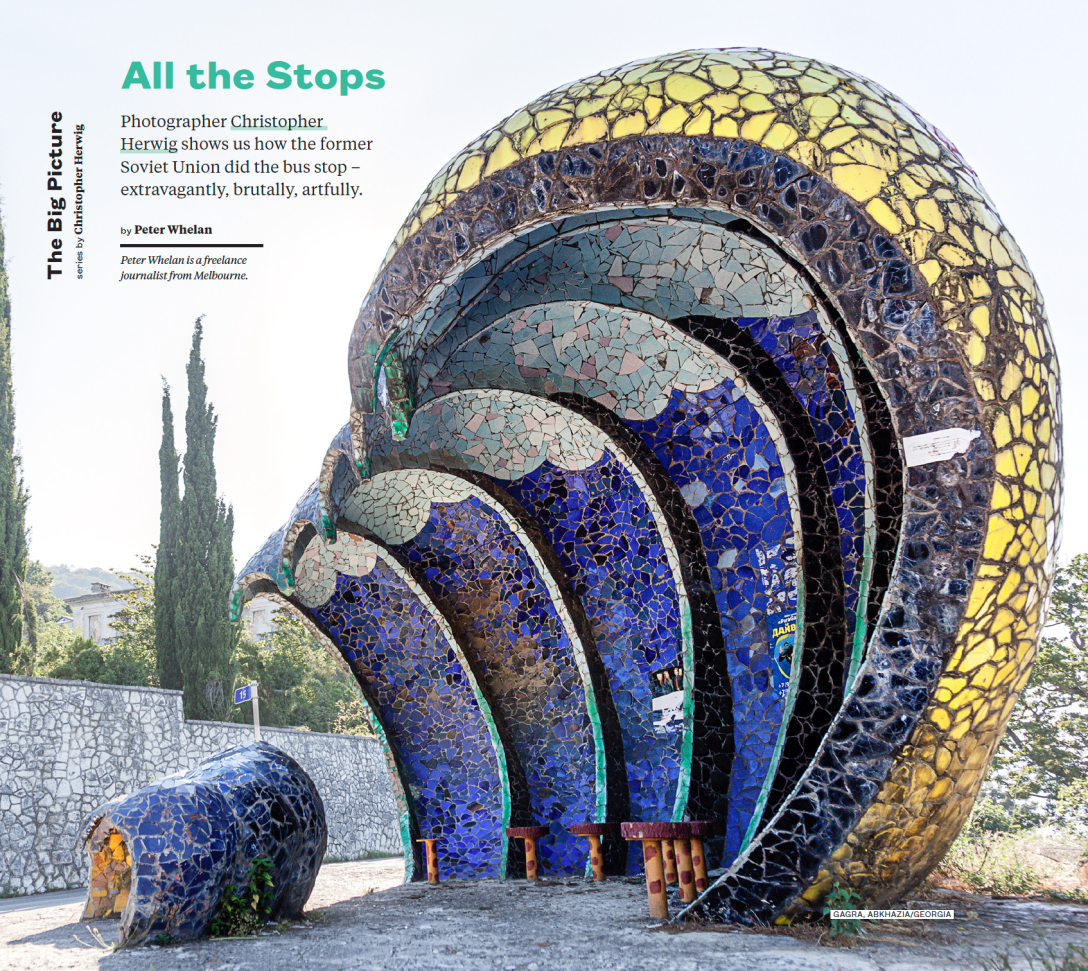
Located in Taraz, Kazakhstan, this example is one of hundreds that Herwig, self-professed bus stop hunter, has documented since 2002 as part of his Soviet Bus Stops project, spanning over 50,000 kilometres and 15 former Soviet countries. 

Herwig stumbled across the first by happenstance, cycling from London to St Petersburg. “You think of these things you want to photograph in terms of iconic monuments, or images, but you’re working your butt off on the bike and things are flying by, and it’s never the perfect National Geographic photograph moment,” Herwig says. “So, on this trip I decided I wanted to just photograph ordinary things to get the creative juices flowing, so to speak.” 

Crossing into Eastern Europe, Herwig noticed that “stuff started popping up on these little country roads,” bizarre bus stops that he soon realised were littered throughout each of the former Soviet republics. Among them were jagged brutalist structures in Armenia, intricate Gaudí-esque mosaics in Ukraine, and multi-limbed retro-futuristic monstrosities in Estonia. Each, while unique, defied the utilitarian prefabricated concrete aesthetic typical of the Soviet era’s state-sanctioned architecture. Herwig found himself poised at the intersection of the mundane he initially sought, and the fantastical. “These were really extraordinary,” Herwig says. “They were ordinary, but extraordinary.” 

Bus stops were classified under the lowest tier of Soviet public infrastructure, able to fly under the radar of the Soviet Union’s rigid design guidelines. “A big part of how it started was George Chakhava,” Herwig says of the Georgian architect responsible for some of the earliest bus stops. “He was the Deputy Minister of the Ministry of Automobile Roads, but he was also an architect, and an artist, and he actually commissioned himself. After that point, you see a lot of other artists inspired by his creativity.” 

Twenty-two years, three books and one documentary later, Herwig has collected stories from communities that house many of the bus stops. “In Estonia, this group of factory workers just needed a shelter because there was a bus coming. But this thing looks like a spider – it’s got quite a number of legs. I asked them, ‘Did this design come from the state? Were you encouraged to make this interesting?’ And the answer was, ‘No, we just wanted a bus stop. No-one told us to do this. We just did it.’” But, in the creatively suppressed environment, Herwig says, “The important thing is that no-one told them not to do it, either.” 

 FOR MORE, VISIT HERWIGPHOTO.SMUGMUG.COM. 

The Big Issue: Force of Nature

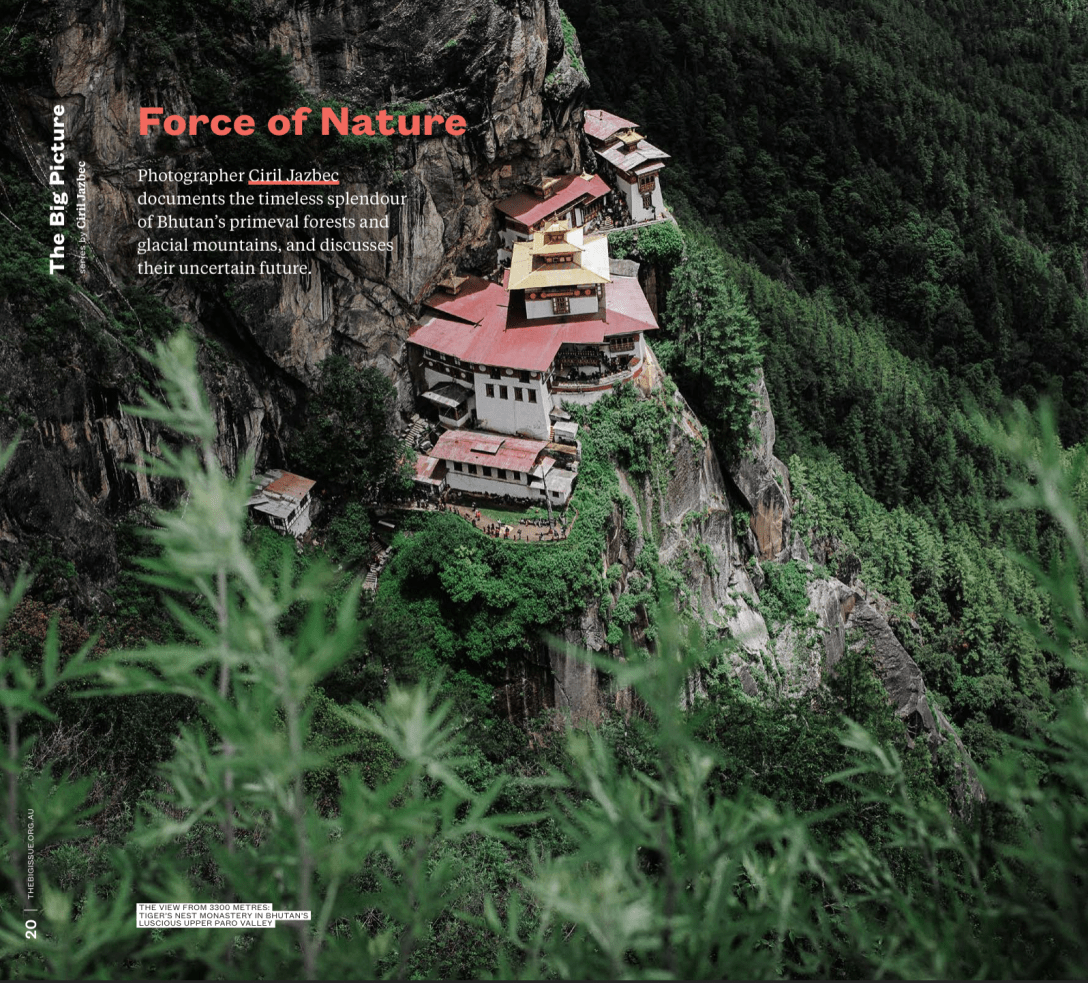
Photographer Ciril Jazbec documents the timeless splendour of Bhutan’s primeval forests and glacial mountains, and discusses their uncertain future.

In a world beset by a reluctance to tackle global warming, the ancient wilds of Bhutan are a breath of fresh air, literally. This tiny kingdom on the eastern edge of the Himalayas is one of the few countries on Earth that is not just carbon neutral, but carbon negative.

“Bhutan is a carbon sink,” says photographer Ciril Jazbec. He was inspired to travel to Bhutan when he discovered their constitutional commitment to keeping 60 per cent of land as permanent forest. “The nature is magnificent. I was amazed by their vast forests and the variety of plants, so naturally I was trying to find a small community that would reflect all that. Laya seemed to be the one.”

Located in Jigme Dorji National Park, Laya is a peaceful village by the Tibetan border, nestled in the foothills of the Tsenda Kang mountain, its glaciated peak piercing the low-hanging mist that lingers over many of Jazbec’s subjects. “Reaching Laya took three very long days of trekking,” the Slovenian photographer says. “It felt like entering another planet where time has stopped, and you feel very grateful to have the opportunity to be there.”

Largely informed by its mostly Buddhist population, Bhutan’s coexistence with its thriving ecosystem is symbiotic. More than two-thirds of the country is protected as national park, nature reserve or wildlife sanctuary, and a network of biological corridors has been established between each to allow wildlife free rein across the country. And while it’s not illegal to consume meat in the largely vegetarian nation, it’s all imported, as the butchering of animals for consumption is banned.

“I saw many white horses roaming through remote settlements,” Jazbec says. “And I rarely saw animals tied up. When people need to use them, they’ll just climb the mountains to find them. There’s something special about their relationship with nature and all living beings. For instance, I once tried to get rid of a fly on the screen of my laptop in the evening and my fixer [the local guides who accompany tourists to the region] almost started to cry.”

Green though it may be, Bhutan has begun to feel the effects of the planet’s changing climate. In recent years, Jazbec says, the country has been subject to shrinking glaciers and water reservoirs, as well as flash floods and landslides. “[It’s] forcing the nomadic people of the remote settlements in the Eastern Himalaya to adapt to survive,” he says. “These yak-herding pastoralists live among the glaciers and migrate to lower altitudes every winter.”

Bhutan’s government has responded by stressing the importance of sustainable buildings, electric vehicles and a high-value, low-impact tourism strategy to ease the burden the country’s ecosystem and, by extension, its way of life.

During Jazbec’s travels, he followed and lived with Tshering, a yak herder whose ongoing relationship with the land provides a stark perspective on Bhutan’s changing environment. “His camp is located right next to the glacier,” Jazbec says. “He showed me how the glacier has shrunk in the last few years. He’s worried what might happen when the glacier finally melts.”

SEE MORE OF CIRIL JAZBEC’S WORK AT CIRILJAZBEC.COM.

Melbourne Music Community Rages as Tote Owners Double Down (Audio/Article)

The crowdfunded #SaveTheTote campaign recently hit a snag when the venue’s owners held out for more money. Contributors like Asia (pictured) aren’t too happy. Find out more about the latest developments in the unfolding saga that is the Tote’s sale.

Peter Whelan

April 25, 2023

The notoriously sticky carpets of the Tote have played host to generations of Melbourne’s music fans over the decades, as well as plethora of Australian rock royalty from local legends like Paul Kelly, You Am I, and the Hoodoo Gurus to international stars including the White Stripes and Mudhoney.

The venue was  recently listed for sale , now finding itself in the midst of escalating controversy following an unexpected change in sale conditions after a successful crowdfunding campaign that sought to secure its future as a live music venue.

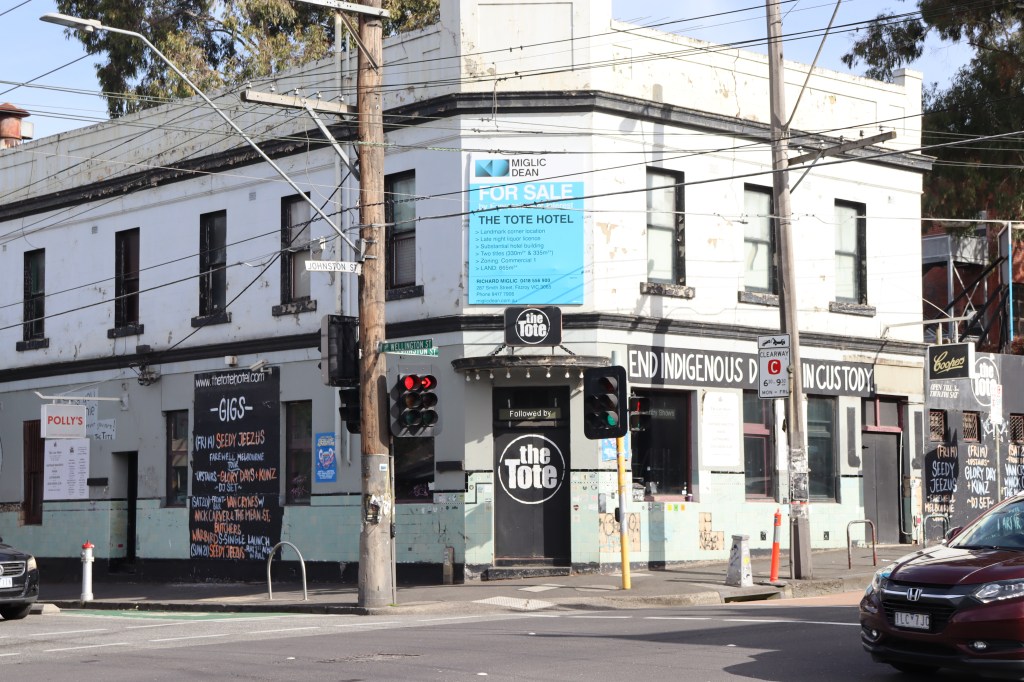
The Tote, located on the corner of Smith and Wellington streets in Collingwood, has long been considered an institution in Melbourne’s live music scene. PHOTO: PETER WHELAN

Eager to prevent the sale of the venue to property developers, Last Chance Rock & Roll Bar owners Shane Hilton and Leanne Chance had launched a  crowdfunding campaign  with the goal of buying the Tote and placing it in a public trust in order to give it “to the bands of Melbourne forever.”

Hilton and Chance pledged $3 million of their own money and sought to raise an additional $3 million from the public campaign on crowdfunding platform Pozible. 

“Let’s not beat around the bush…”, the campaign description began,

“THE TOTE IS GOING TO BE TURNED INTO APARTMENTS (or worse one of those fucking awful redeveloped tissue box pubs ran to make as much money as possible with no dirty rock & roll in sight…”

“In other words, the Tote is dead and some asshole developer is going to get it,” it continues.

“We’ve managed to hustle and can (with going into a shit load of debt to banks, family and using our own meagre [sic] savings) manage to put up half of that money.

“What we need to do is raise the other half.”

As part of the campaign, Hilton vowed to tattoo the names of all contributors on his body and the Last Chance hosted all-night live streams featuring performances from local artists as the live music community rallied to save the venue.

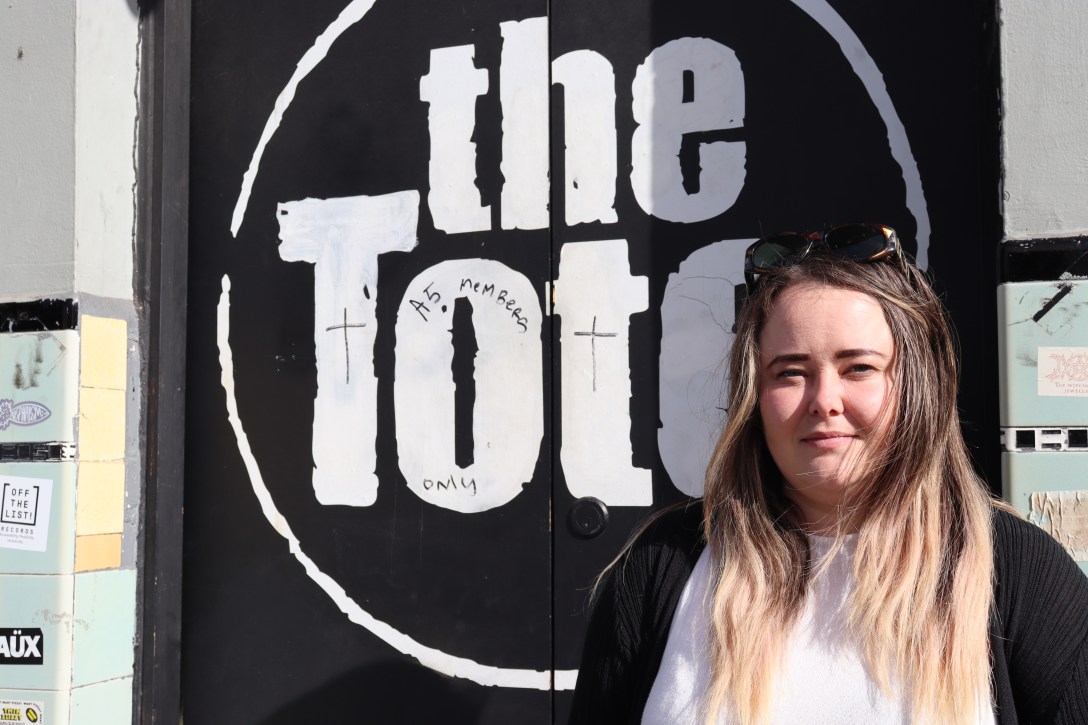
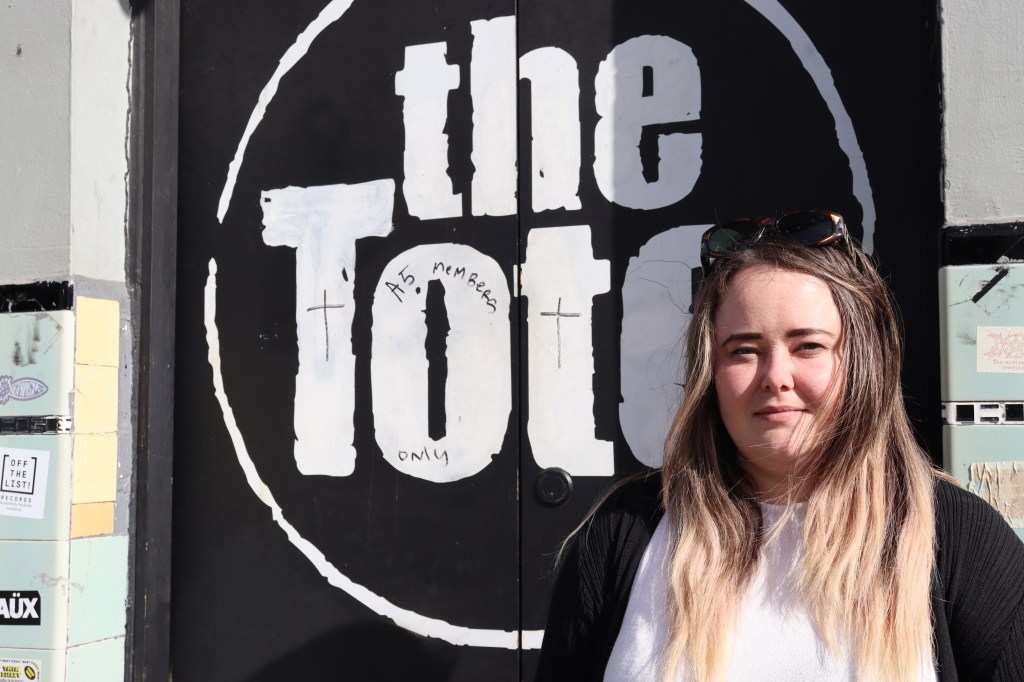
“Pretty much anyone I know who’s in the Melbourne music scene, I met at the Tote.” Asia Taylor contributed to the crowdfunding campaign to save the venue. PHOTO: PETER WHELAN

Among those who contributed to the crowdfunding campaign was Asia Taylor, part owner and band booker of Abbotsford live music venue Lulie Tavern, band photographer and co-host of music podcast the L Files. 

I asked Asia what motivated her to contribute to the Save the Tote campaign.

“I wanted to support Shane and Leanne,” she said.

“It got to a couple $100,000 pretty quickly, and when it hit a million, I realised that it could be possible and it could be saved. I thought, ‘I need to be a part of this.’ There’s some amazing memories there, and if I had the money, I’d save it as well.”

On March 6, the Save the Tote campaign reached its three million dollar goal,  a record amount for the Pozible platform. 

However, a matter of hours later,  a post appeared on the Tote’s Instagram account  from Tote owners Sam Crupi and Jon Perring.

“The Tote would like to thank everyone that pledged to the Last Chance Pozible campaign to try and buy the Tote. It’s a stunning result for the community to reach the $3m target,” the post began, before shifting in tone.

“The current asking price is $6.65m and is based on the land value,” the post began, explaining that the owners had arrived at the figure with help from a “respected and qualified valuer” to allow for “the mortgage, all liabilities and the current owners to be paid out fairly.”

“The price is possibly even conservative by some measures,” Perring and Crupi wrote, suggesting that “governments and private philanthropy would need to come on board” to address the “shortfall between community pledges.”

Commenters were swift to express their disdain in the comments section. 

Commenters unleashed fury in the now-deleted comments on Perring and Crupi’s post. SOURCE: Instagram

That night at the Tote, punk band  Uncle Geezer left the stage after playing only one song  in protest over Crupi and Perring’s decision.

“If you don’t know what’s going on, look at the Tote page,” said a band member. “Fuck this place, it deserves to get sold to Hillsong. You guys want the whole set? Come to Last Chance tomorrow. Enjoy the rest of the set, that will be six hundred thousand dollars.”

Uncle Geezer invited the audience to their free Last Chance Rock & Roll bar show the next day, where every ticket had been paid for by an unnamed ‘prominent member of Melbourne’s music industry.’

Negotiations between the Last Chance owners and the Tote owners are ongoing, but Hilton remains optimistic. 

“The journey is still continuing,”  he told Broadsheet .

“The campaign ending didn’t mean it would automatically sell, but we are confident we’ll get the purchase.”

Appraising the Intangible: Victoria’s Cultural Heritage Problem (Feature Article)

Deep into the heart of Melbourne’s CBD, I roamed. I had been led on a fool’s errand, and now found myself blindly fumbling through peak-hour foot traffic, searching for a non-existent parcel collection point. I heard a familiar voice call out to me. Looking around, I couldn’t find its source among the blank, vaguely discontent faces of the rat race. “Pete!” the voice cried again. That’s when I realised it was coming from inside the construction site. I poked my face through a gap in the fence and found myself face-to-face with an old friend: Ian Ostericher.

I first met Ian on his wedding night. After tying the knot, he and his new bride Bianca had decided on a whim to visit Lulie Tavern, the dive-bar in Abbotsford where I work. After I insisted on toasting their new union with the Tavern’s finest tequila – Clase Azul Reposado – the three of us became fast friends. 

Ian is an archaeologist. For many, the mention of archaeology conjures images of exotic adventure in Greece or Egypt, but this site was a salvage excavation of Aboriginal artefacts, Ian said, explaining that Melbourne’s CBD stands on land rich with Indigenous history, the archaeological extent of which is unknown.

My curiosity piqued, I lured Ian to the Tavern to tell me more that evening with the promise of one of my famous margaritas and hurried home to do some research before my shift. Before I knew it, we’d set up an interview to be conducted over still more margaritas.

After some research, I discovered the junction of three remarkably different realms: commerce, science and spirituality: the world of Cultural Heritage Management. This is legislation created by the Aboriginal Heritage Act in 2006 that established corporations composed of traditional land owners called Registered Aboriginal Parties (RAPs). Their primary role, as laid out by the Act, is to function as the “primary guardians, keepers and knowledge holders of Aboriginal cultural heritage” of the land they represent.

When a development is proposed within a RAP’s boundaries, the developers must first consult with the Elders of the RAP to determine if the land is an area of cultural sensitivity. If so, that developer must hire an archaeologist certified in heritage management, in this case Ian, to create a Cultural Heritage Management Plan assessing the extent of Aboriginal heritage in an area, as well as plans for its preservation and maintenance should the development proceed.

After being appointed Cultural Heritage Manager for a site, Ian first conducts a ‘desktop assessment’ to gather the stories, history, and background data of the area through his own research and consultation with the RAP.

“What does that involve?” I asked Ian as a Tommy’s margarita was set down before him. 

“I’ll ask if there are any stories about this part of the world that have any bearing on what we might find, or on how we should be dealing with it, sensitivity-wise,” he replied. 

Do we know if there was women’s business, or men’s business or sorry business here?  An example would be, now we actually know that this is an area that has a lot of women’s business, then we only have women run the project. So men don’t touch any of the data, men don’t touch anything, and then reports are redacted according to who can view it. You’re saying like, hey, look, we are on your side. We really care,” Ian said

Next, his team conduct standard and complex assessments of the land itself under the supervision of the RAP. The first is a survey, looking for unburied artefacts and surface damage which could affect the potential archaeology below. The second is a subsurface excavation of test squares to determine the concentration of artefacts on the site. In the event of high artefact concentration, a salvage excavation is carried out to unearth and preserve the objects. 

  “It’s important to remember that these places aren’t just archaeological sites. The information that they contain is, in a lot of ways, sacred to Aboriginal people,” Ian explains. “It’s the interaction between the land and the object. When we do repatriations and reburials, we do a smoking ceremony and then rebury the objects on the same type of landform they were excavated from in a bottomless box, so it’s still in contact with the earth. We also bury it with the ontological report. Almost like a little time capsule. So you’re paying homage to both lineages of knowledge.”

Every link in the chain of Cultural Heritage Management ascribes value differently. For the Aboriginal people, it is a spiritual connection to Country. For the archaeologist, it is discovery and science. For the developer, it is business – the completion of a project to their client on time and on budget. Ian’s job, translating between these different spheres, seemed like alchemy to me.

“On any particular job, I have three clients,” Ian said. “As a business, I’ve got a financial obligation to the developer. Then there’s the ethical client – the science of collaborative practice. Making sure the claims that we’re making about the past are as evidenced as well we possibly can make them where we don’t over-interpret or under-interpret evidence. And then, third, there’s the moral client in the traditional owners of the land. My work is sometimes at odds with the idea of self determination and the control of their own land. It’s difficult. ”

To get a better idea of the different forces at work in this challenging exercise, I spoke to another of my regulars at Lulie Tavern. Tom Muratore has an extensive background in commercial and multi-residential property development in Melbourne. I’d noticed that the flow of money during the heritage management process came exclusively through the developer, who pays the archaeologists, the supervising members of the Registered Aboriginal Party, and consultation fees for every meeting with the party Elders. The Heritage Act seemed to me to support privatisation and a resulting lack of transparency that I hoped Tom could explain to me.

I met with him in his company’s showroom to discuss the Cultural Heritage Management process from his point of view. Warm and obliging, Tom put a pot of filter coffee on for us while fielding endless phone calls from Chinese supply companies and obscenely wealthy clients who wanted their antique chair legs dipped in brass.

“I want to make one thing clear,” Tom cut in curtly as I waxed lyrical to him about my impressions. “It’s got nothing to do with the developer. Everyone now just anticipates [Cultural Heritage Management] happening and adds a fee on to it. And as it gets worse, the prices have been escalating. The price of real estate in Australia is caused by this kind of bureaucracy. Our building cost in Victoria is higher than anywhere else in Australia.”

“I just think we’re just generating work. How does money solve a heritage problem? Where does that money go? Is that money going directly to Aboriginal communities? Or is it going into another bureaucracy?”

It’s clear that Tom comes from a very different place to Ian. His concerns are based on the completion of the job he has been contracted to do. His frustration with the bureaucratic process is also echoed by other developers in Victoria.

 In submissions to the Victorian Government’s Inquiry into Establishment and Effectiveness of Registered Aboriginal Parties, Westwind Energy wrote that over $750,000 was “required to be spent without any certainty that a project would be approved on cultural heritage grounds, let alone other planning grounds,” while VicRoads wrote that many RAPs “are now charging rates substantially higher than those recommended in the Guidelines in what has become a highly inflationary unregulated charging environment.”

There were also several submissions to the Inquiry, many heavily redacted, from traditional land owners. Many had seen their application for RAP status denied or ignored by the Victorian Aboriginal Heritage Council, resulting in loss of income and community credibility. When a traditional land owner is excluded from RAP status, they cannot hold events that generate money for their communities, like traditional smoking ceremonies and speeches of welcome.

In his statement to the Inquiry, Neil Clark of the heritage advisory firm Clarkeology said the process of RAP appointment “is a competitive application process whereby two groups come in and they are both really being asked to say, ‘My claim for historical connection is stronger than your claim for historical connection’. Usually there is only one group selected, so there are winners and losers. It just seems to me that is an inherently unfair process. I do not dispute that the groups who have got RAP status deserve RAP status, but what about everybody else?”

To better understand the spiritual connection between Aboriginal people and Country, I reached out to Emily Poelina-Hunter, whose status as Reconciliation Lead for the City of Melbourne, lecturer of Aboriginal Studies at La Trobe University, doctor of archaeology and Aboriginal woman put her in a position to provide unique insight. I wanted to know if it was possible for a Cultural Heritage Management Report to sufficiently communicate the importance of Country in Aboriginal culture.

“I definitely think there is a way that the spiritual importance of Country can be written about in English for CHMPs,” Emily said, “but I think it would be best done by an Indigenous writer who is comfortable with academic scientific English – because this is a bit different to conversational everyday English. Translating anything from an Aboriginal language into English is hard enough to find equivalent words with similar meaning. And then anthropologists and archaeologists use their own academic terminology and categorise things in ways that kind of don’t always capture the essence of Aboriginal words. 

“And when it comes to something seemingly intangible – like spiritual connection to Country – it is super hard to put something that complex into words.

“I’ve been watching Selling Houses Australia on Foxtel, and the respect for 1920s art deco bathrooms, or a 100 year old house built during the gold rush in Bendigo blows my mind. Or people having to sell a house that has been in their family for 80 years is really sad. Give me a break! If they get that, why can’t they just times it by 500 and grasp 1000s of generations of families being connected to and caring for Country?”

Emily’s comparison to Selling Houses Australia was apt. Ascribing value to Aboriginal connection to Country seemed like an exercise in metaphysics, particularly through the bureaucratic maze of the Heritage Act. But what’s the alternative, and should we be appraising the intangible at all?

Pete Whelan