In New Jersey, the General Pencil factory has worn its blue collar proudly since 1889. Family owned and operated for six generations, not a whole lot has changed during that time. But then again, neither have pencils.
This is not lost on New York-based photographer Christopher Payne. “A pencil is such a simple, humble, everyday object that you take for granted, that there’s power in,” he says. “And it’s like that because you don’t expect it to be.”
Inside General Pencil, striking red-and-white patches emblazoned on charcoal work shirts slice through the darkness of the factory floor, announcing the names of each employee in cheerful cursive script. “It’s sort of uniformly black and grey down there,” says Payne of the space, where every surface seems to be coated with a fine layer of powdered charcoal and graphite. “Stuff is going to get on your clothing. I went in there and thought Oh God, how am I going to photograph this? It’s going to be really, really challenging because it’s just so dark.”
Day to day, members of the crew (comprised largely of New Jersey locals) go about their work on old but carefully maintained machines that shave wood with perfect precision, unspool strands of graphite like fresh fettuccine, and spray fine, glossy coats of candy-coloured mist. “Everywhere you look has a notch in it, or a groove. Nothing is clean and tidy. It’s all this giant Willy Wonka Santa’s workshop that’s been in use for 100 years,” Payne says.
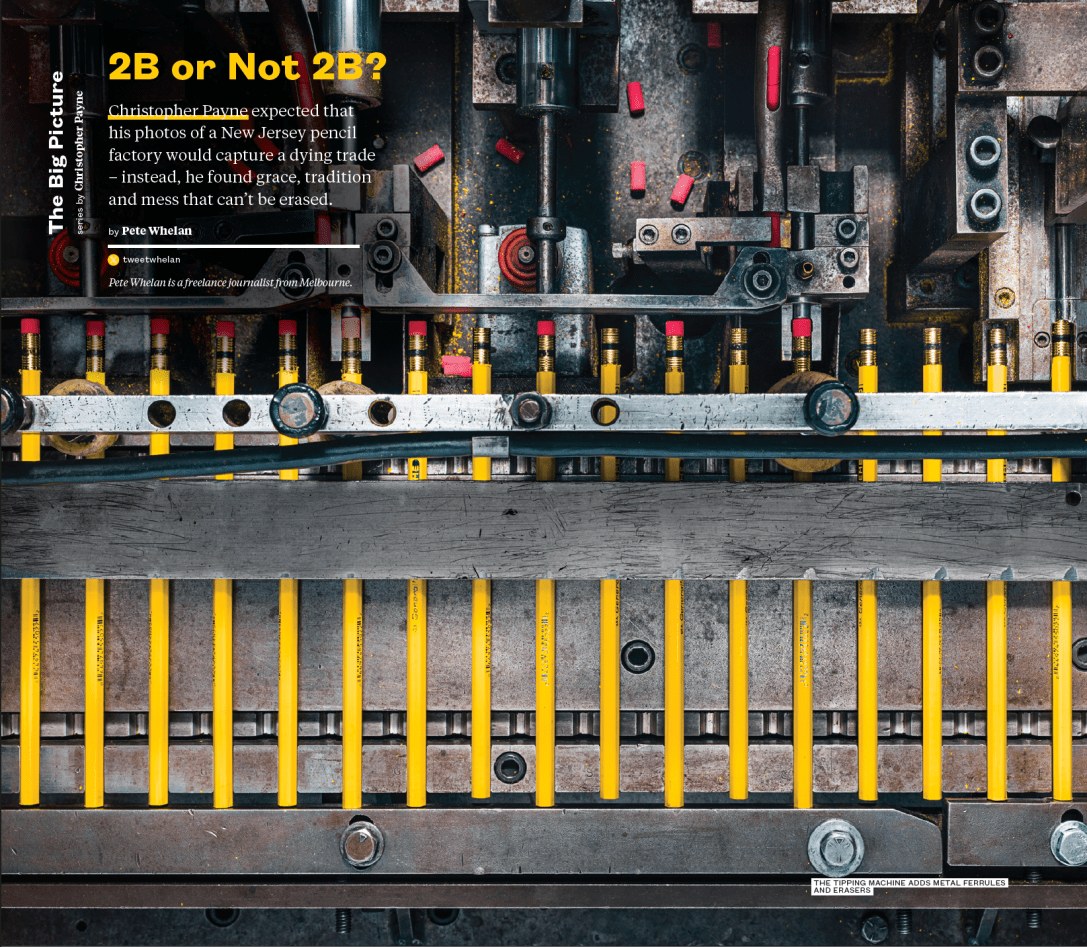
Payne’s favourite shot “shows this sequence of yellow pencils, marching in progression. It’s shot from above, and it shows the erasers and the ferrules (the metal bands that attach erasers to pencils) being put on the yellow pencils. It’s just this beautiful mechanical operation, very traditional, but very unique to the making of pencils.” The picture adorns the cover of his book, Made in America: The Industrial Photography of Christopher Payne.
Initially, when Payne asked permission to shoot in the factory, he was interested in what he refers to as “the documentation of the obsolete”. Not thrilled about being portrayed in that light, the owners initially denied Payne access. “I realised later that no company wants to be portrayed as a dinosaur,” says the photographer, who went and shot New York’s Steinway Piano factory instead. Impressed by the results, General Pencil’s owners relented and granted Payne access to the factory, allowing him to visit dozens of times between 2016 and 2018.
As he got friendly with many of General Pencil’s workers, Payne felt his focus shift. Having set out to document the obsolete, he realised the photos he was taking spoke to something else: a celebration of the proud tradition of American manufacturing and craftsmanship. “I was fascinated by the way the workers moved, and I wanted to capture them at their most graceful point,” he says. “That moment of elegance when they look like dancers while they’re working. They don’t look clumsy or old or tired, but they have a certain grace to them that honours what they’re doing.”
FOR MORE, VISIT CHRISPAYNEPHOTO.COM
 Pete Whelan