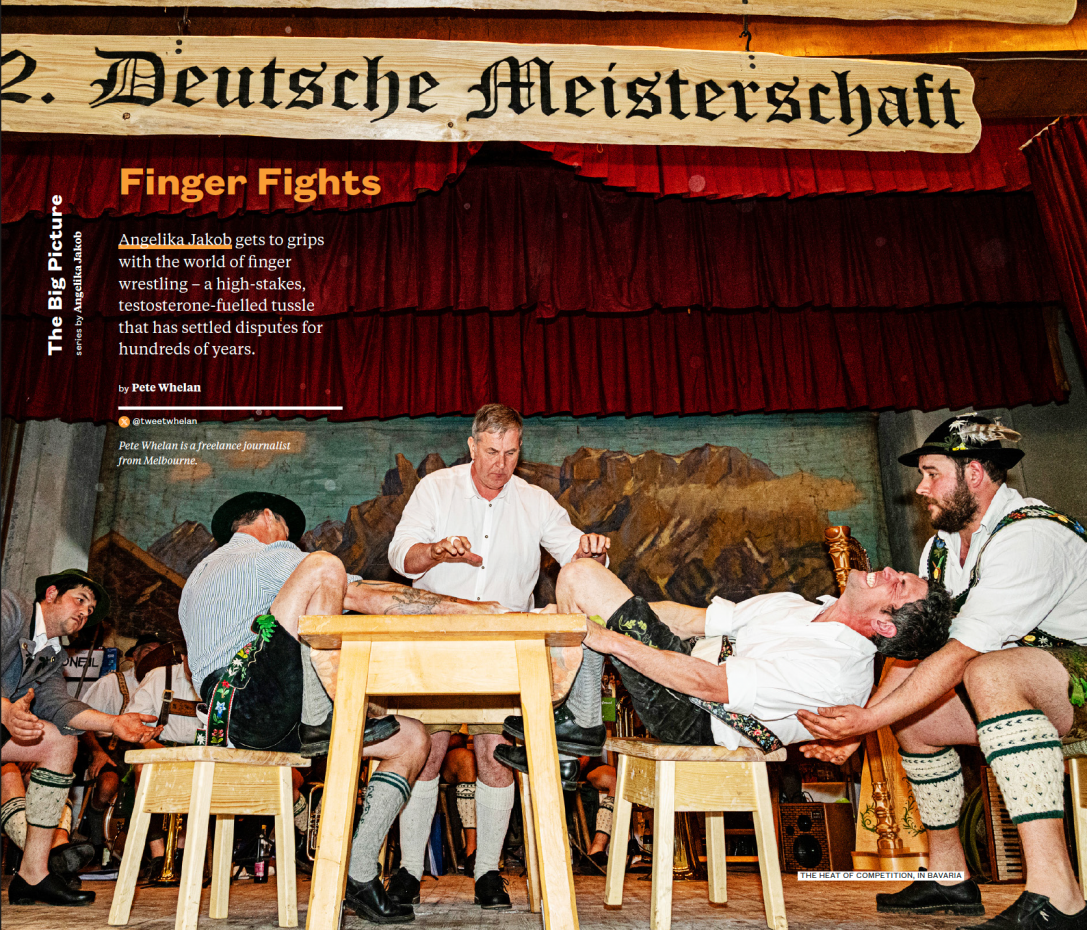
In the dim glow of a carpentry workshop in Ohlstadt, Bavaria, Josef Utzschneider attaches a 51-kilo cement block to a pulley system and lifts it, using only his middle finger, as if it were a bag of groceries. “I remember watching him do it and thinking that it seemed like nothing to him,” recalls Munich-based photographer Angelika Jakob of Utzschneider’s training for the German Finger Wrestling Championship.
The rules of finger wrestling (known locally as fingerhakeln) are simple. When the referee yells “Zieht!” you pull until either you or your opponent succeeds in dragging the other’s finger across their edge of the table. It’s like a tug of war, on a small scale. A typical match lasts about 10 seconds. Utzschneider, once called the “Usain Bolt of finger wrestling” by the Süddeutsche Zeitung (one of Germany’s largest daily newspapers), has been known to finish his opponents in under two.
Each time Utzschneider hooks his enormous finger through the leather loop used to bind him to his opponents, he carries his family legacy on his broad palms. His father was a champion, his grandfather was a champion, his great-grandfather was a champion, and he is a champion – many times over. He tells Jakob that genetics are key – big, strong hands run in the family. “Family tradition on the one hand, physiognomy on the other. Luckily, he is careful when he shakes hands,” she adds. “Otherwise, he could have crushed me.”
Sometimes there are injuries. “People bleed,” confides Jakob, “But they [the finger wrestling community] don’t like it to be mentioned. That kind of publicity is not good for the sport, so I stayed away from that, and I think they appreciated it.” Instead, Jakob stood back and observed, earning the competitors’ acceptance when they understood she was not there to poke fun at their passion. “In a situation like that, it’s important not to ask too many stupid questions,” she reflects. “Better to just let them do their thing.”
Finger wrestling is said to have its roots in the 14th century, when it was used to settle disputes in the Alpine region. Now it’s an organised sport, with the annual German Finger Wrestling Championship the main event. Men and boys clad in traditional Lederhosen fill the long wooden tables, lined with pork and steaming dumplings. At last year’s festival there were 163 competitors across 440 matches starting at 10am – with regular beer breaks, of course. “The atmosphere was a mixture of tension and fun – it’s like a soccer game, with the amount of investment from the audience – they take it very seriously, but it’s fun, too,” Jakob says. “It’s mostly only men in attendance. It’s a man thing,” she adds.
In the end, Utzschneider walked away with another victory. “They don’t do it for the prizes,” Jakob says. “They do it for fame and honour. Being a champion of finger wrestling bestows a revered status in their village – it’s a badge of recognition from their community.”
FOR MORE, VISIT ANGELIKAJAKOB.COM.


 Pete Whelan