The Big Issue: Finger Fights

 In the dim glow of a carpentry workshop in Ohlstadt, Bavaria, Josef Utzschneider attaches a 51-kilo cement block to a pulley system and lifts it, using only his middle finger, as if it were a bag of groceries. “I remember watching him do it and thinking that it seemed like nothing to him,” recalls Munich-based photographer Angelika Jakob of Utzschneider’s training for the German Finger Wrestling Championship. 

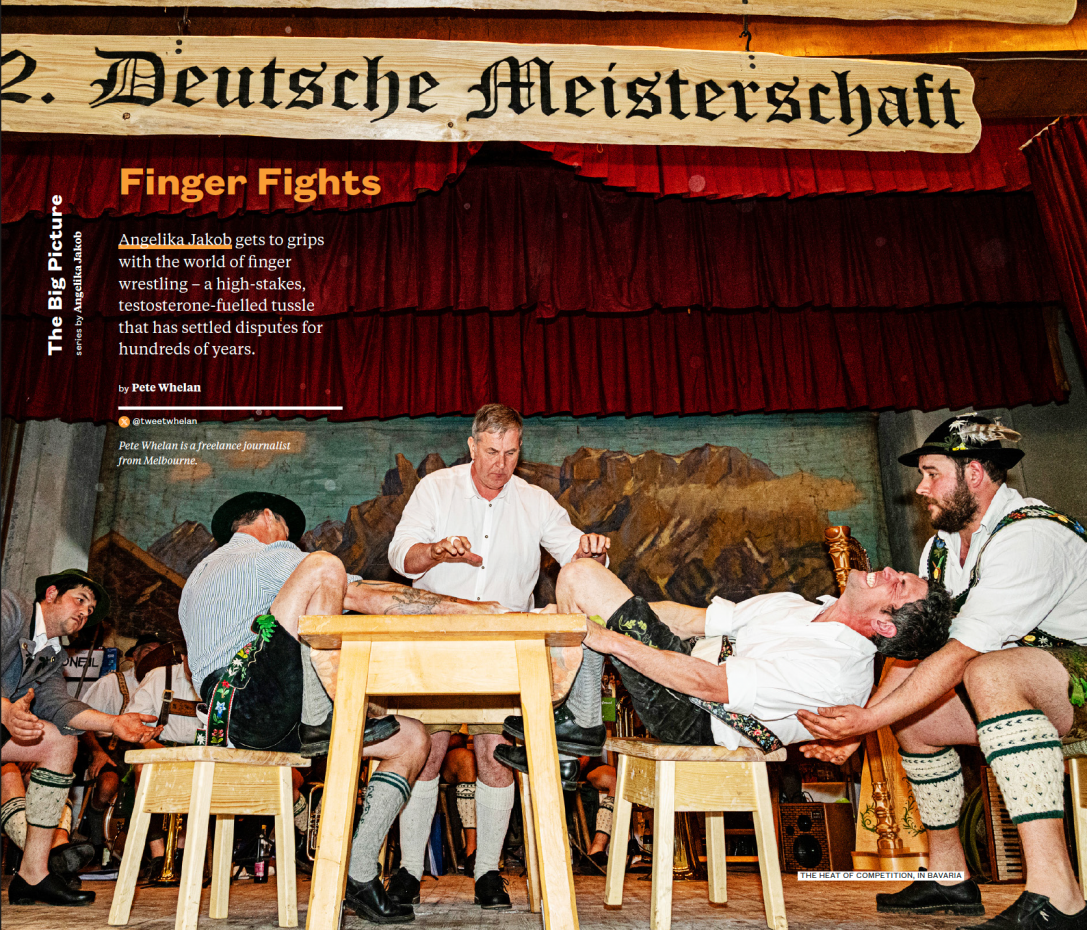
The rules of finger wrestling (known locally as fingerhakeln) are simple. When the referee yells “Zieht!” you pull until either you or your opponent succeeds in dragging the other’s finger across their edge of the table. It’s like a tug of war, on a small scale. A typical match lasts about 10 seconds. Utzschneider, once called the “Usain Bolt of finger wrestling” by the Süddeutsche Zeitung (one of Germany’s largest daily newspapers), has been known to finish his opponents in under two.

Each time Utzschneider hooks his enormous finger through the leather loop used to bind him to his opponents, he carries his family legacy on his broad palms. His father was a champion, his grandfather was a champion, his great-grandfather was a champion, and he is a champion – many times over. He tells Jakob that genetics are key – big, strong hands run in the family. “Family tradition on the one hand, physiognomy on the other. Luckily, he is careful when he shakes hands,” she adds. “Otherwise, he could have crushed me.”

Sometimes there are injuries. “People bleed,” confides Jakob, “But they [the finger wrestling community] don’t like it to be mentioned. That kind of publicity is not good for the sport, so I stayed away from that, and I think they appreciated it.” Instead, Jakob stood back and observed, earning the competitors’ acceptance when they understood she was not there to poke fun at their passion. “In a situation like that, it’s important not to ask too many stupid questions,” she reflects. “Better to just let them do their thing.” 

Finger wrestling is said to have its roots in the 14th century, when it was used to settle disputes in the Alpine region. Now it’s an organised sport, with the annual German Finger Wrestling Championship the main event. Men and boys clad in traditional Lederhosen fill the long wooden tables, lined with pork and steaming dumplings. At last year’s festival there were 163 competitors across 440 matches starting at 10am – with regular beer breaks, of course. “The atmosphere was a mixture of tension and fun – it’s like a soccer game, with the amount of investment from the audience – they take it very seriously, but it’s fun, too,” Jakob says. “It’s mostly only men in attendance. It’s a man thing,” she adds. 

In the end, Utzschneider walked away with another victory. “They don’t do it for the prizes,” Jakob says. “They do it for fame and honour. Being a champion of finger wrestling bestows a revered status in their village – it’s a badge of recognition from their community.” 

FOR MORE, VISIT ANGELIKAJAKOB.COM. 
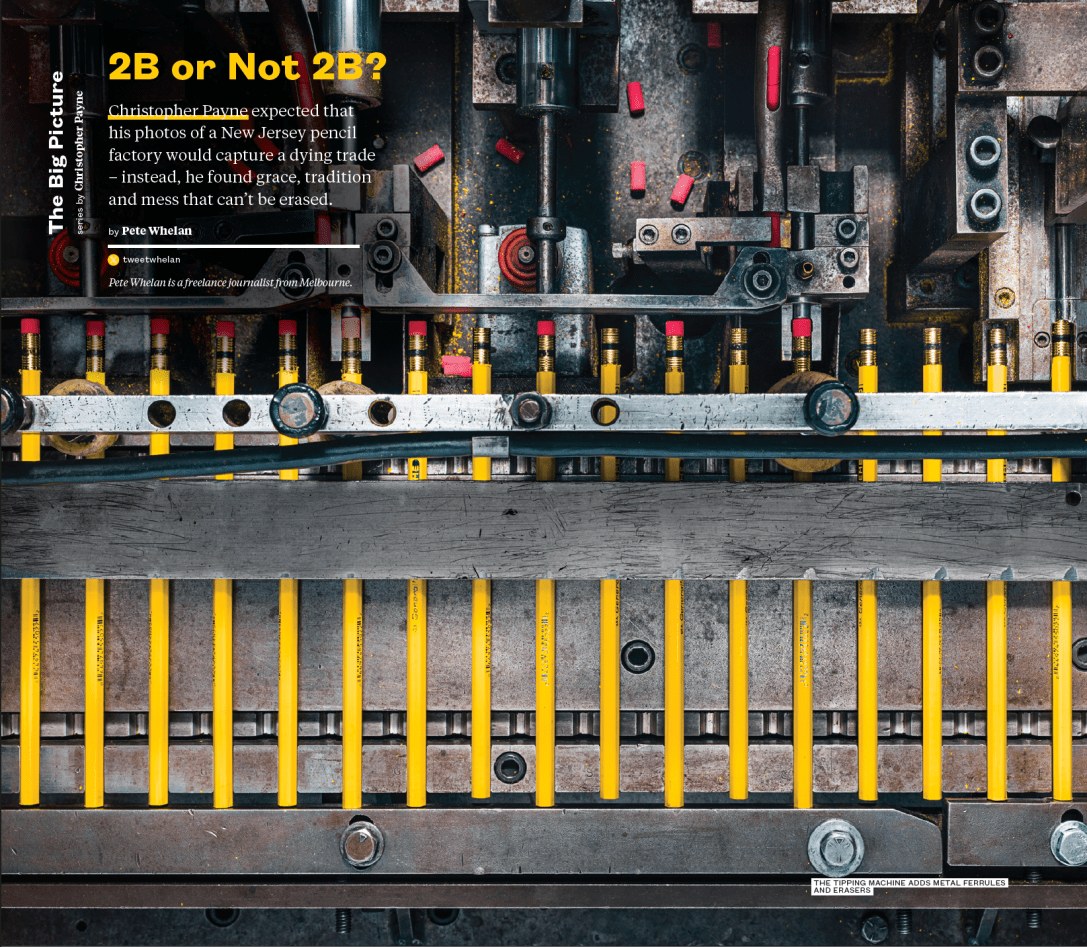
The Big Issue: 2B or Not 2B?

 In New Jersey, the General Pencil factory has worn its blue collar proudly since 1889. Family owned and operated for six generations, not a whole lot has changed during that time. But then again, neither have pencils. 

This is not lost on New York-based photographer Christopher Payne. “A pencil is such a simple, humble, everyday object that you take for granted, that there’s power in,” he says. “And it’s like that because you don’t expect it to be.” 

Inside General Pencil, striking red-and-white patches emblazoned on charcoal work shirts slice through the darkness of the factory floor, announcing the names of each employee in cheerful cursive script. “It’s sort of uniformly black and grey down there,” says Payne of the space, where every surface seems to be coated with a fine layer of powdered charcoal and graphite. “Stuff is going to get on your clothing. I went in there and thought Oh God, how am I going to photograph this? It’s going to be really, really challenging because it’s just so dark.” 

Day to day, members of the crew (comprised largely of New Jersey locals) go about their work on old but carefully maintained machines that shave wood with perfect precision, unspool strands of graphite like fresh fettuccine, and spray fine, glossy coats of candy-coloured mist. “Everywhere you look has a notch in it, or a groove. Nothing is clean and tidy. It’s all this giant Willy Wonka Santa’s workshop that’s been in use for 100 years,” Payne says. 

Payne’s favourite shot “shows this sequence of yellow pencils, marching in progression. It’s shot from above, and it shows the erasers and the ferrules (the metal bands that attach erasers to pencils) being put on the yellow pencils. It’s just this beautiful mechanical operation, very traditional, but very unique to the making of pencils.” The picture adorns the cover of his book, Made in America: The Industrial Photography of Christopher Payne. 

Initially, when Payne asked permission to shoot in the factory, he was interested in what he refers to as “the documentation of the obsolete”. Not thrilled about being portrayed in that light, the owners initially denied Payne access. “I realised later that no company wants to be portrayed as a dinosaur,” says the photographer, who went and shot New York’s Steinway Piano factory instead. Impressed by the results, General Pencil’s owners relented and granted Payne access to the factory, allowing him to visit dozens of times between 2016 and 2018. 

As he got friendly with many of General Pencil’s workers, Payne felt his focus shift. Having set out to document the obsolete, he realised the photos he was taking spoke to something else: a celebration of the proud tradition of American manufacturing and craftsmanship. “I was fascinated by the way the workers moved, and I wanted to capture them at their most graceful point,” he says. “That moment of elegance when they look like dancers while they’re working. They don’t look clumsy or old or tired, but they have a certain grace to them that honours what they’re doing.” 

 FOR MORE, VISIT CHRISPAYNEPHOTO.COM

The Big Issue: Gust for Life

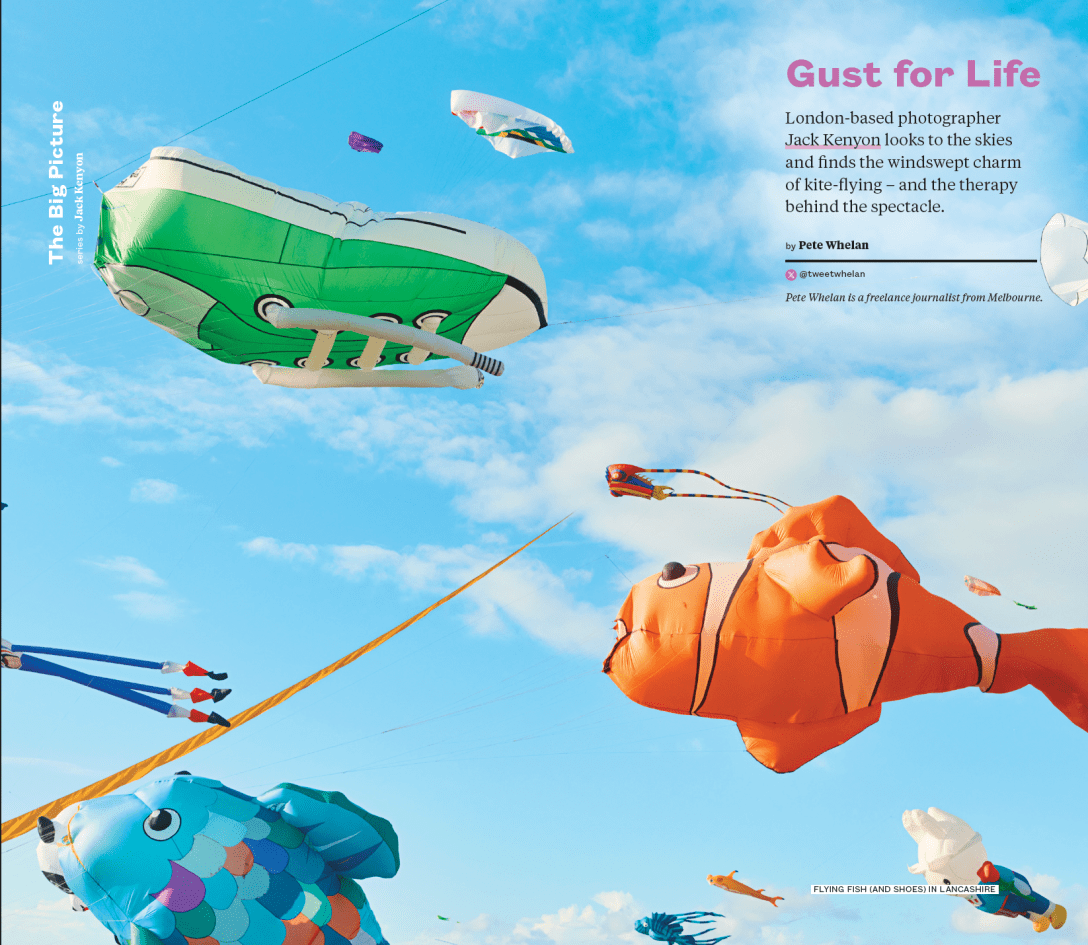
 It’s a bird, it’s a plane…it’s-a me, Mario? When you see a giant plumber undulating in the Atlantic breeze high above a beach in Lancashire, you realise that truly anything is possible. Attracting scores of kite enthusiasts from around the world, the St Annes International Kite Festival lashes vivid colours onto the grey coastal skies, transforming this stretch of beach into a fever dream where ripstop nylon meets unrepentant whimsy for one wild weekend. 

London photographer Jack Kenyon is often drawn to the more eccentric corners of British community life, counting giant vegetables, dog shows and an official swan census among the projects in his portfolio. When he accepted a commission to cover the kite festival, though, he did not find the polite pastime he expected. Rather, he was confronted with a very specific kind of misery: British weather. 

“It was howling wind, lots of rain, then sunshine, then torrential rain,” Kenyon says. “It’s on this really long, muddy, depressing English beach. It’s so bleak, and yet it was packed with hundreds and hundreds of people. You’ve got this grey backdrop, but then you look up and there’s a giant unicorn. Some kites are 10 to 15 feet long – just humongous. You can’t fly them by hand. People tie them to their cars. If you held on, you’d just fly away.” 

The kites aren’t the only things getting carried away. According to Kenyon, attendees’ budgets regularly blow out, too. “I was surprised at how fanatical people were. Their whole cars were filled with different kites,” he says. “It’s not a cheap hobby – they’re spending all their cash on it.” People travel from all over the world: “Texas, South Africa, Australia,” he explains, “bouncing between these big international festivals like a summer road trip. I didn’t even know this existed.” 

Things have certainly come a long way since the diamond-shaped wood and paper kites of yore. With designs driven by technology, creativity and daredevilry, the sky is the limit. “There’s a whole range,” Kenyon says, recalling the weird and wonderful kites on display over the weekend, including Tyrannosaurus rexes, whales and dragons. “You have mega pointy racer ones – stunt kites where you can do loops. And then you have people making bespoke kites from bamboo and bound plants, while others have 3D printers and are making their own high-tech ones.” 

Like their kites, the pilots on the ground pulling the strings aren’t always what you’d expect. “It wasn’t just sweet little children,” says Kenyon. “It was definitely what you’d call an alternative scene. There was a guy there who was a roadie for big rock bands, and people flying psychedelic mushroom kites. It was quite eclectic.” 

Ultimately, though, all of these seemingly disparate groups are drawn together by the therapy of the upward gaze. “Compared to other hobbies that are solitary or competitive, there’s no real purpose to this,” Kenyon muses. “It’s just a nice way to spend your day outside in the fresh air. You don’t achieve anything – that’s the point.” 


 FOR MORE, VISIT JACKKENYON.XYZ 

The Big Issue: All The Stops

 “There was nothing but the Kazakh Steppe all around us – grassland that just goes on for ever and ever. It’s almost like the sea. We were driving on a tiny little road that slowly started to disappear until it was actually gone,” says Canadian photographer Christopher Herwig. “All the grass was just kind of standing up behind us, and we realised we didn’t know where the road was anymore. For about an hour, we panicked. We didn’t know whether to go north, south, east or west – it was as if we were in a boat in the middle of the ocean.” Eventually, Herwig found what he had been searching for: a strange angular structure of faded white concrete that brings to mind a dog sitting obediently, nestled in the Steppe’s yellow grass. It was a bus stop. 

Located in Taraz, Kazakhstan, this example is one of hundreds that Herwig, self-professed bus stop hunter, has documented since 2002 as part of his Soviet Bus Stops project, spanning over 50,000 kilometres and 15 former Soviet countries. 

Herwig stumbled across the first by happenstance, cycling from London to St Petersburg. “You think of these things you want to photograph in terms of iconic monuments, or images, but you’re working your butt off on the bike and things are flying by, and it’s never the perfect National Geographic photograph moment,” Herwig says. “So, on this trip I decided I wanted to just photograph ordinary things to get the creative juices flowing, so to speak.” 

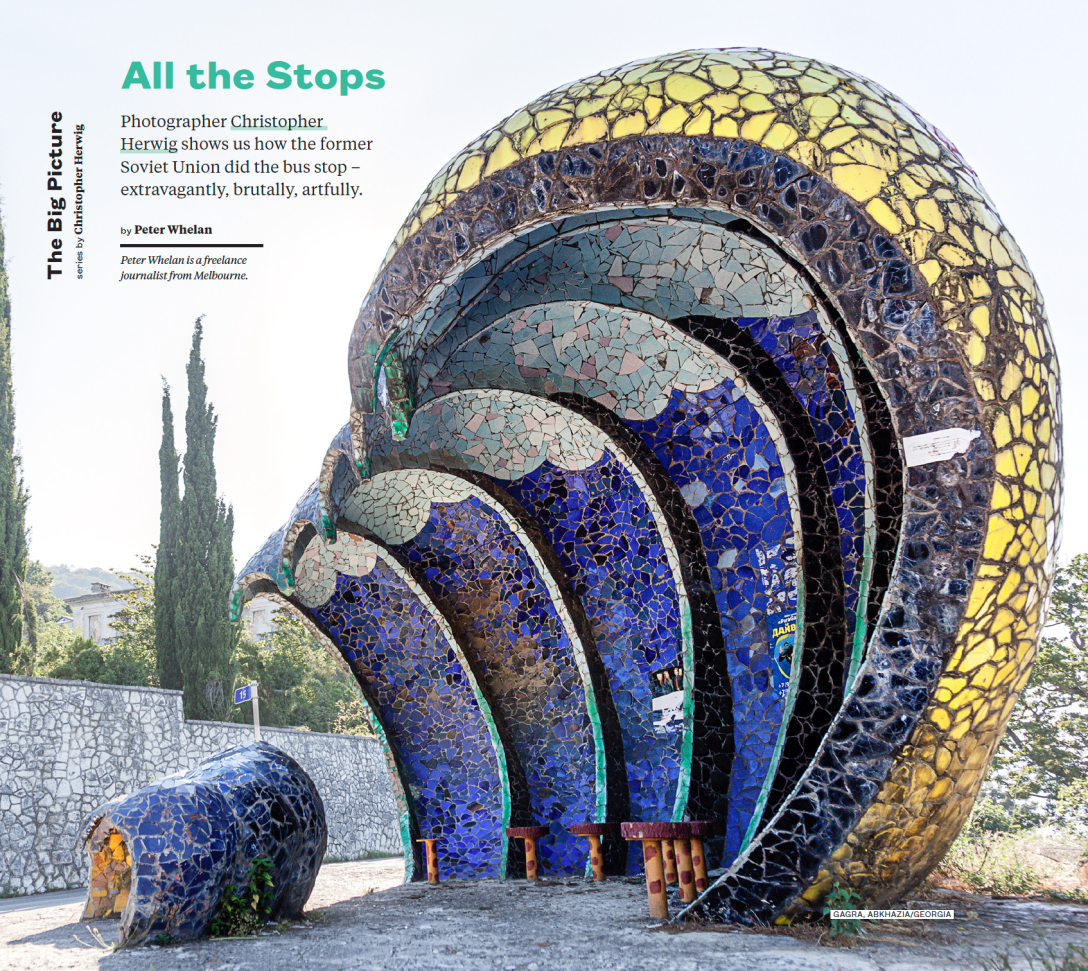
Crossing into Eastern Europe, Herwig noticed that “stuff started popping up on these little country roads,” bizarre bus stops that he soon realised were littered throughout each of the former Soviet republics. Among them were jagged brutalist structures in Armenia, intricate Gaudí-esque mosaics in Ukraine, and multi-limbed retro-futuristic monstrosities in Estonia. Each, while unique, defied the utilitarian prefabricated concrete aesthetic typical of the Soviet era’s state-sanctioned architecture. Herwig found himself poised at the intersection of the mundane he initially sought, and the fantastical. “These were really extraordinary,” Herwig says. “They were ordinary, but extraordinary.” 

Bus stops were classified under the lowest tier of Soviet public infrastructure, able to fly under the radar of the Soviet Union’s rigid design guidelines. “A big part of how it started was George Chakhava,” Herwig says of the Georgian architect responsible for some of the earliest bus stops. “He was the Deputy Minister of the Ministry of Automobile Roads, but he was also an architect, and an artist, and he actually commissioned himself. After that point, you see a lot of other artists inspired by his creativity.” 

Twenty-two years, three books and one documentary later, Herwig has collected stories from communities that house many of the bus stops. “In Estonia, this group of factory workers just needed a shelter because there was a bus coming. But this thing looks like a spider – it’s got quite a number of legs. I asked them, ‘Did this design come from the state? Were you encouraged to make this interesting?’ And the answer was, ‘No, we just wanted a bus stop. No-one told us to do this. We just did it.’” But, in the creatively suppressed environment, Herwig says, “The important thing is that no-one told them not to do it, either.” 

 FOR MORE, VISIT HERWIGPHOTO.SMUGMUG.COM. 

The Big Issue: Lap of the Gods


The Bathurst 1000 is Australia’s most beloved motorsports event, but beneath the pageantry lies one of the world’s most dangerous racetracks.


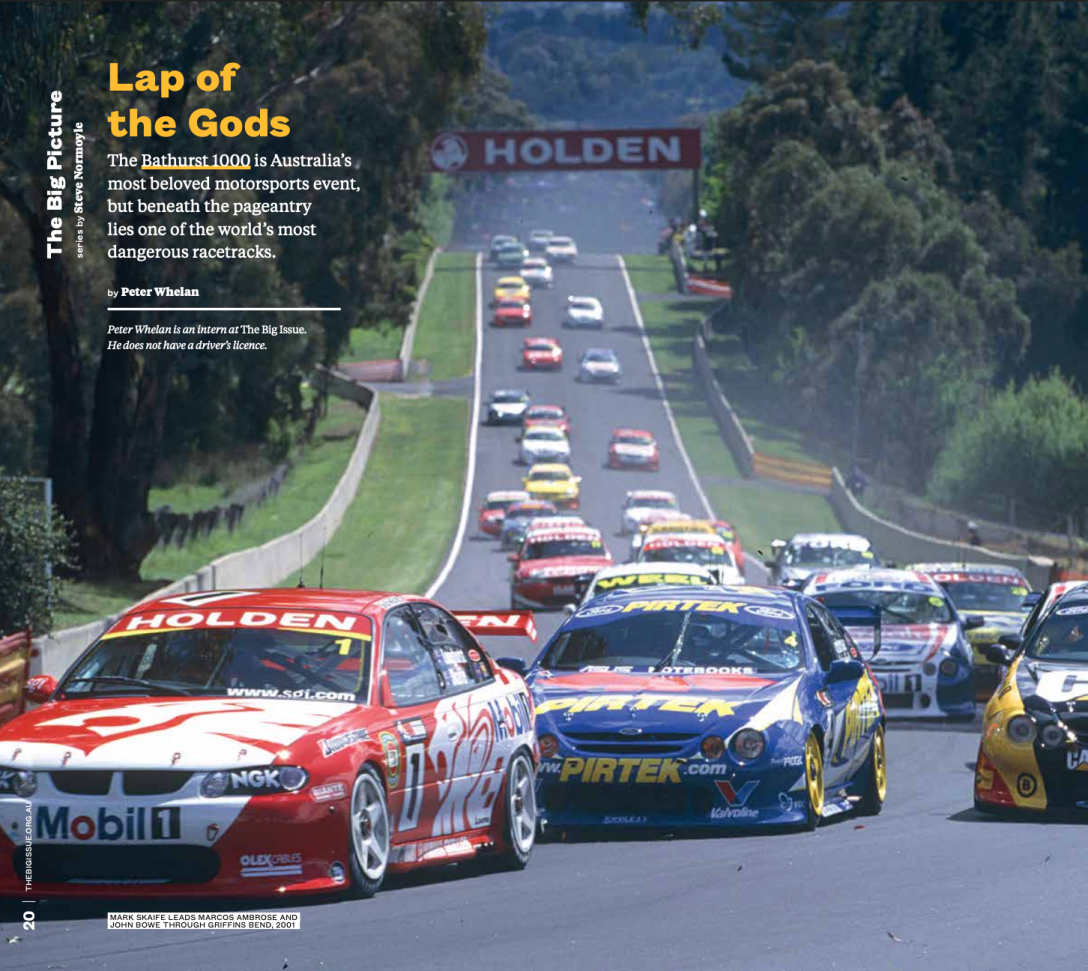
Much has changed over the 60 years of the Bathurst 1000. Once a testing ground for unmodified sedans from car dealerships, the track now swarms each October with V8 Supercars emblazoned with corporate logos. They hurtle along the winding road at speeds in excess of 200 kilometres an hour. Since day one, though, the summit of Mount Panorama in the NSW town has quietly presided over the squealing tires and photo finishes – its sharp hills and hairpin bends at the heart of one of the world’s most unique motorsport events.

 “It’s an extreme place,” says Steve Normoyle, author of Bathurst: 60 Years of the Great Race. The photo-driven chronicle documents the 161-lap race’s “many tales of triumph and tragedy” over the years. There’s Peter Brock’s staggering 1979 win, which saw him and Jim Richards place six laps ahead of their nearest competitor. Also featured is Richards’ controversial win in 1992, when torrential rain and numerous crashes – including one involving Richards’ leading Nissan GT-R – caused the race to be stopped and the clock wound back. Perhaps mercifully, however, all images of David Reynolds swilling champagne from a shoe after his 2017 victory have been omitted.

 “If I ever won Bathurst, there wouldn’t be a shoey,” Normoyle laughs. Despite these moments of levity, Bathurst is not for the faint of heart. “If you built that track today and tried to use it for car racing, the authorities would laugh at you. It would be considered too dangerous on all sorts of levels,” says Normoyle of the 1000km track. “The drivers themselves all talk about it being the only place where one of their competitors is the circuit itself. You don’t need to be a motorsport enthusiast to watch it and understand just how difficult it is.” 

Normoyle says the “sheer elevation change, the run across the top of the mountain, the drop off the end, and the long run down Conrod Straight” make the track so risky. “In the early days, there were no fences around the top,” he explains, “so if a car crashed off the inside of the circuit, it often rolled down the mountain. It was very much frontier stuff.” The challenges for the drivers aren’t limited to the difficulty of the track – they must also contend with Mount Panorama itself. One of the mountain’s more famous interventions in the race came in 1980, when driver Dick Johnson’s iconic “TRUBLU” Ford Falcon XD struck an errant rock on the track. “In one of the 12-hour races one year, there was a lot of rain,” says Normoyle. 

“During the race, a tree on the inside of the circuit fell across the track. I don’t think that’s ever happened at any motorsport event in the world. “Ironically,” he adds, “it’s probably one of the safer tracks for a photographer.” The elevation allows viewpoints that other tracks could not accommodate. The images Normoyle has compiled tell a story so vivid, you can almost smell the engine oil and burnt rubber. 

But after poring over thousands of photos in the archives, the photographer has yet to decide on his favourite. “If you ask me, any picture of a car at Mount Panorama is worth looking at,” he says with the air of a man who loves his job.